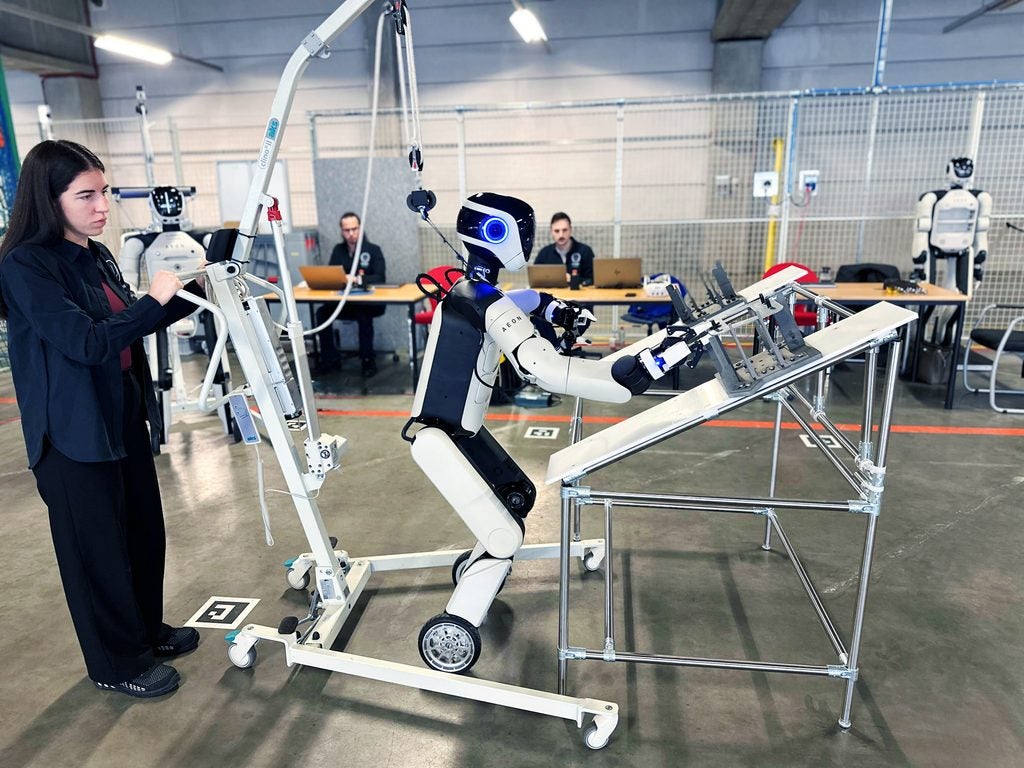
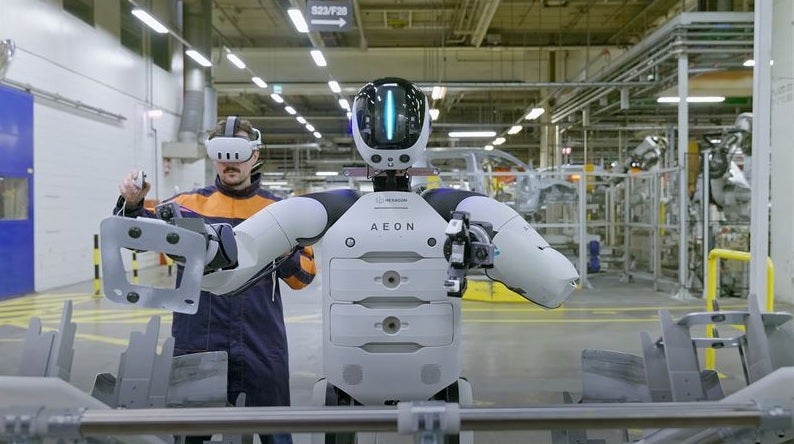
Geely-owned Volvo Cars says it has brought AEON humanoid robots to its manufacturing plant in Ghent, Belgium, where they are being trained and validated on real industrial tasks.
The company says the aim is ‘supporting employees in repetitive and ergonomically challenging work’.
Ghent is the first Volvo Cars plant to try humanoid robots, which are currently learning alongside employees and existing automation ahead of a factory pilot in 2027. The goal is safer, more flexible and more efficient manufacturing. The programme is part of Volvo Cars’ wider investment in advanced manufacturing.
Volvo Cars’ own team is training the robots in close collaboration with the Robotics division of Swedish technology group Hexagon. The team uses imitation learning, where the robot picks up a task by copying how it’s done. The first task is placing components into two fixtures with high precision.
As each step is proven, the team will gradually make the work more challenging, such as handling multiple parts, moving around the production area and interacting with the plant’s automated systems.
Why the human shape?
Robot arms and other fixed automation have been part of car manufacturing for a long time, and they are excellent at stable, highly repetitive work in a set location. But some ergonomically challenging tasks need a level of flexibility that fixed robotic arms can’t offer.
“AEON’s humanoid design means it can fit into our production as it is today, alongside our teams and existing automation,” says Magnus Nilsson, Chief Manufacturing Officer at Volvo Cars. “Our aim is for humanoid robots to take on some of the most physically demanding tasks and help make work more ergonomic for our people.”
The robot is 1.65 metres tall and weighs 60 kilograms. It uses cameras and sensors to capture its surroundings and handle parts with precision. Instead of feet, it moves on wheels, reaching up to 2.4 metres per second – about the pace of a light jog – and it can carry 10 kilograms. Designed as a multi-purpose platform, AEON can be trained for different industrial tasks, paving the way for more applications.
Towards production in mid-2027
The training lays the groundwork for a factory pilot in the first half of 2027, when more AEON units will arrive in Ghent to take on a wider range of tasks. The aim is for the robots to be used in real production from mid-2027.
“The purpose of humanoid robotics is to deliver business value to our customers,” says Arnaud Robert, President of Hexagon Robotics. “Working closely with Volvo Cars’ teams allows us to ensure AEON performs real-world tasks that support their manufacturing process.”