


Road transportation is essential. Whether moving people or goods, it supports society and economic growth.
Reducing greenhouse gas (GHG) emissions from commercial fleets is a significant challenge. Nearly 25% of worldwide CO2 emissions are estimated to come from transportation, with almost 75% of those emissions coming from road transportation[i].
Commercial transportation is complex, and there is no one-size-fits-all solution.
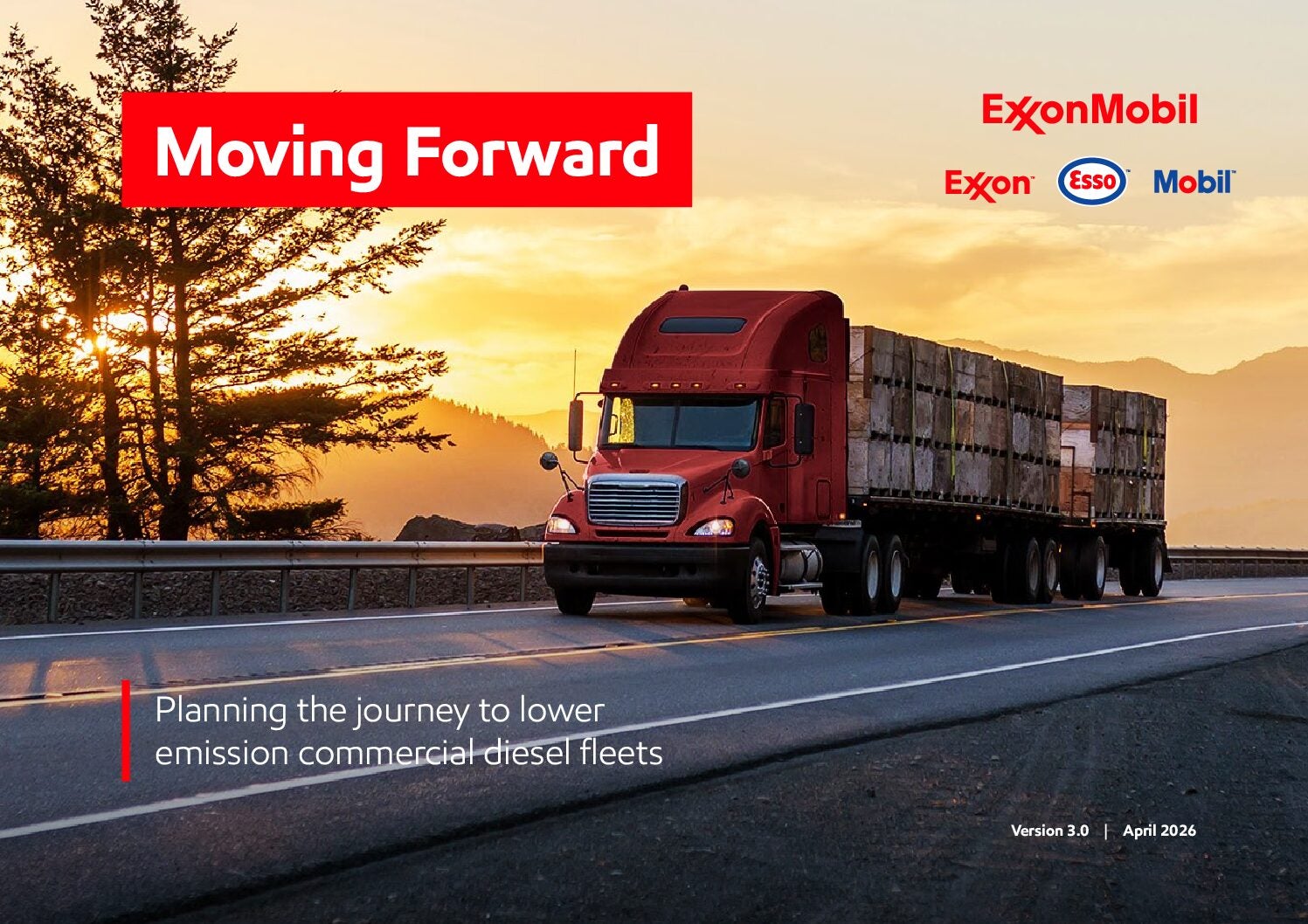
An ExxonMobil white paper, Moving forward: planning the journey to lower emission commercial diesel fleets, provides key insights to efficiently and effectively transition to lower-emission fuels. Available to download for free below.
Many fleet managers will already be evaluating their options for reducing fleet emissions. However, what is clear is that for most operators there won’t be a single route towards lower GHG emissions from their operations.
As we’ve already seen, mixed fleets and complex operational patterns will require a range of solutions, now and in the future. From additized diesel to new vehicles running on novel fuel formulations, the range of options is large and increasingly complex.
Also, fleet managers may choose a staged progression between choices over time as infrastructure is built and regulatory policies evolve. ExxonMobil therefore suggests that fleet managers assess their short- to long-term options to help devise a path that meets both their operational requirements and emission reduction goals.
With this in mind, operators should generally first look at relatively simple measures that can be implemented today, and can make a difference, including:
- Making an inventory of GHG emissions.
- Establishing fuel efficiency and emissions reduction goals.
- Leveraging inter-modal options where feasible to replace truck tonne miles with rail where it is a feasible option and represents a viable lower GHG emission choice.
- Secure win-win-wins (productive use of assets, lower fuel consumption/costs per ton mile and lower associated emissions), by optimising diesel consumption of the existing truck fleet
- Enhancing attention to reducing empty miles driven to eliminate unproductive truck miles.
- Increasing emphasis on data analytics and telematics.
- A renewed focus on fuel efficient driving practices, underpinned by driver training.
- Switching to running the fleet on detergent-additized diesel and use of high-performance lubricants.
Taken together, these measures can help enhance fleets’ day-to-day operations, improve efficiency, lower operating costs and lower emissions per mile driven.
Discover how the world’s largest commercial fleet businesses are preparing for a lower emissions future. Download ExxonMobil’s whitepaper here.
[i] IEA CO2 Emissions in 2022 Report, IEA Tracking Transport Tracking 2023.
