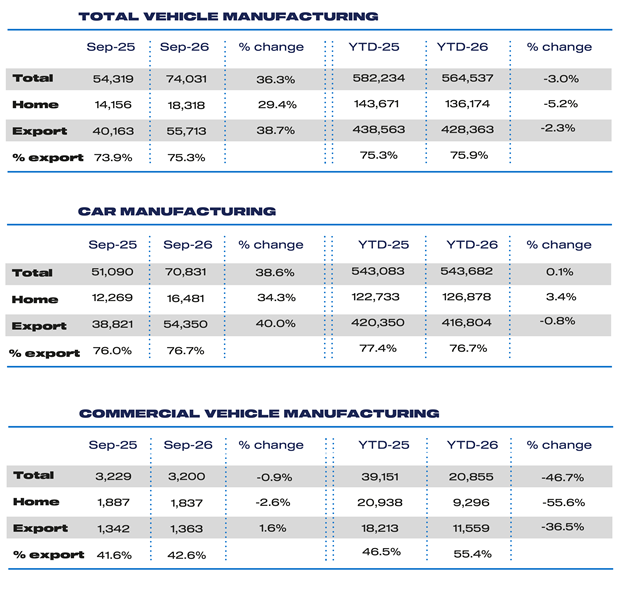


UK vehicle production rose by 36.3% to 74,031 units in September, according to figures published by the Society of Motor Manufacturers and Traders (SMMT).
The growth – the strongest since August 2022 – reflects the impact of an unprecedented cyber incident last year, which saw production stoppages at Jaguar Land Rover (JLR).
Last year, JLR was hit by a cyber-attack that seriously disrupted its manufacturing schedule. Output at JLR UK manufacturing plants in Halewood, Solihull and Wolverhampton (engines) was halted as result of the company’s response to the cyber-attack at the end of August 2025 and the stoppage extended through September and into October.
As a result of that disruption last year, car production increased by 38.6% year-on-year in September, with 70,831 units rolling off factory lines, making it the strongest September for UK car manufacturing since 2023. Electrified models supported growth, with their output up 22.5% to account for more than two-fifths (42.3%) of cars produced in the month and 70.1% of exports. Exports continued to account for more than three quarters of overall output, with 76.7% of all cars built destined for international markets.
Exports to the UK’s three biggest automotive markets rose significantly in the month, led by China, where shipments increased by 357.7%, albeit from a low base, to take a 4.4% share. The US recorded a similarly substantial rise of 234.8%, accounting for 16.8% of the total, while the EU remained the largest global destination, taking 57.5%, with volumes up 12.7% year on year.
Commercial vehicle (CV) exports also grew in the month, up 1.6%, although a -2.6% drop in output for the domestic market left overall production down by -0.9%. Year-to-date performance remains down by -46.7% following structural changes within the sector.
Overall, UK factories built 564,537 cars and CVs in the first nine months, a year on year decline of 3.0%.
Mike Hawes, SMMT Chief Executive, said, “September’s rebound is welcome, but comparison with last year’s disruption masks the pressures on UK manufacturing. Protectionism is becoming a feature of global trade, and that threatens not just UK automotive as an export-led sector, but the health of industries overseas as well.
“Pragmatic discussions with trade partners are required but Government can immediately help the industry with an urgent conclusion to the ZEV Mandate review. Mandate targets are running ahead of demand and draining resources required for British factories and jobs. Substantive changes – not marginal adjustments – are needed to ensure decarbonisation does not come at the cost of reindustrialisation.”