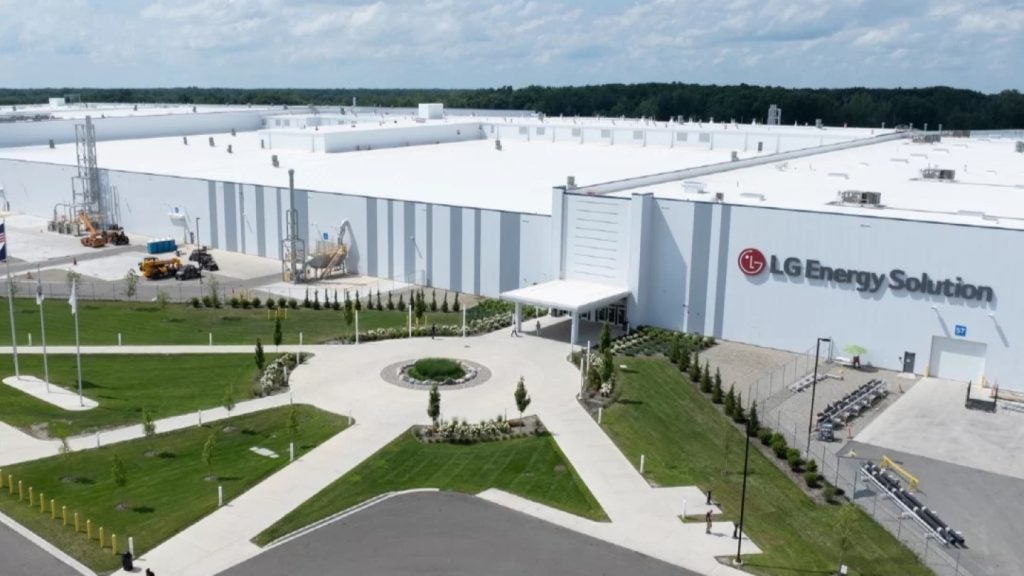
South Korea’s LG Energy Solution (LGES) has begun production at its new battery plant in Lansing, Michigan, US, adding capacity for electric vehicle (EV) and energy storage system (ESS) batteries.
The company is targeting annual battery-making capacity of more than 35GWh at full scale.
The Lansing plant is LGES' second manufacturing facility in Michigan, alongside an existing plant in Holland.
The 226-acre facility will produce lithium-iron phosphate (LFP) cells for ESS applications and nickel-manganese-cobalt (NMC) cells for EVs.
The NMC cells will be supplied to Toyota for EVs including the 2027 Toyota Highlander EV, which will be assembled at Toyota Motor Manufacturing Kentucky in Georgetown, Kentucky.
The ESS cells will be integrated by LGES Vertech, the company's US energy storage division, into systems for utility and grid-scale storage as well as commercial and industrial applications.
DTE Energy, the Detroit-based energy company, will be among the utilities using batteries from the plant for future ESS projects.
LGES has invested more than $2bn in the Lansing facility since 2022.
The plant currently employs about 900 people, with headcount expected to rise to 1,700 at full-scale production.
The company also operates a North American regional group and research and development facility in Troy, Michigan.
Total investment in the state since 2010 exceeds $5bn, and the company's Michigan workforce is expected to surpass 3,300 by the end of 2026.
Across North America, LGES is targeting more than 50GWh of total LFP cell-making capacity by the end of 2026.
This will be spread across three wholly owned plants – Michigan-Holland, Michigan-Lansing, and NextStar Energy in Windsor, Ontario – and two joint-venture facilities, L-H Battery Company in Jeffersonville, Ohio, and Ultium Cells 2 in Spring Hill, Tennessee.
By the end of the year, 80% of the company's global ESS capacity is expected to be based in North America.
LGES CEO David Kim said: “Today marks a defining milestone for LG Energy Solution. Lansing will produce advanced batteries that support not only the future of mobility, but also America’s growing energy infrastructure and digital economy.”
Earlier this month, Ultium Cells, the US-based EV battery joint venture between LGES and US automaker General Motors, confirmed plans to restart production at its plant in Warren, Ohio, following a seven-month shutdown.
The company suspended production at the plant in January, laying off some 1,400 workers, including 850 temporarily.