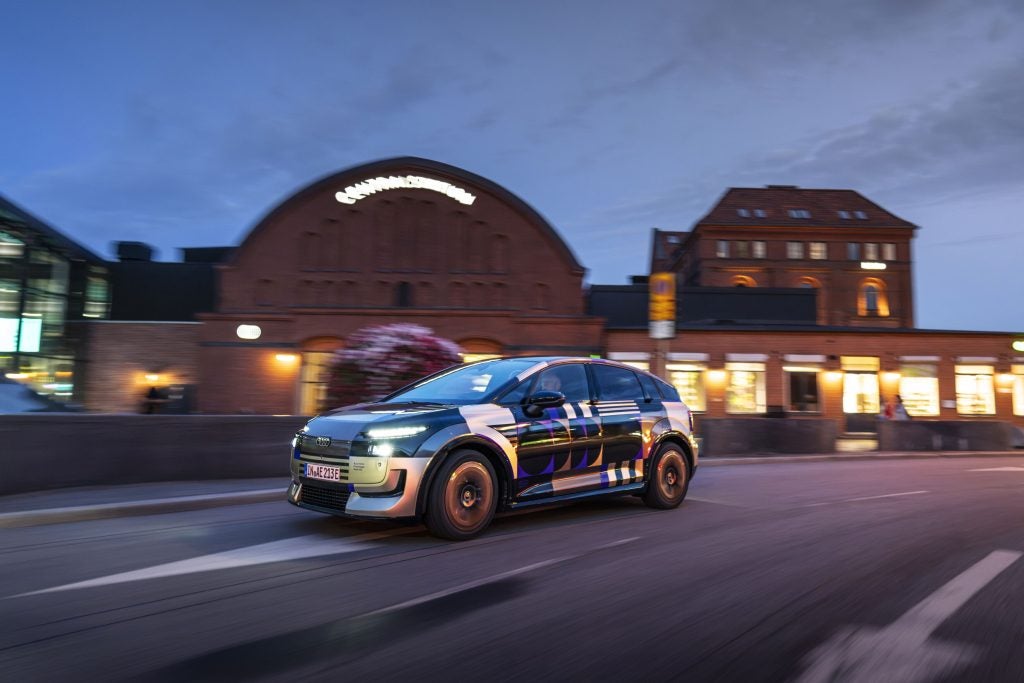
Audi has said the upcoming A2 e-tron is the ‘most efficient Audi of all time’. According to WLTP measurements, the preliminary energy consumption of the upcoming compact electric model in the 140kW (190PS) power level with the optional efficiency package amounts to 12.8 kilowatt-hours per 100 kilometres (4.85 mi/kWh).

Discover B2B Marketing That Performs
Combine business intelligence and editorial excellence to reach engaged professionals across 36 leading media platforms.
This, Audi says, is made possible by advanced drive technology, sophisticated aerodynamics, and a battery optimized for everyday use.
Audi will unveil the new model in the autumn.
“The Audi A2 has been a constant in my career ever since I joined the Volkswagen Group in the 1990s. Even then, its groundbreaking three-litre version made efficiency its hallmark,” said Gernot Döllner, CEO of AUDI AG. “This is precisely the vision we are carrying forward with the new A2 e-tron: outstanding efficiency, excellent everyday usability, and a clear understanding of what customers expect from modern electric mobility.”
Key facts about the Audi A2 e-tron 140 kW with the efficiency package:
- Energy consumption of 12.8 kWh/100 km (preliminary) based on WLTP measurements
- Drag coefficient of 0.24 — the best in Audi’s compact lineup, with aerodynamic measures reducing WLTP energy consumption by up to 0.9 kWh/100 km
- Highly efficient electric drive with advancements in power electronics, the electric motor, and transmission
- A 61-kWh lithium iron phosphate (LFP) battery achieves 89.6 percent charging efficiency at the wallbox with an adapted cooling strategy
- Bidirectional charging: Vehicle-to-Load2 and Vehicle-to-Home3 turn the A2 e-tron into an energy storage system
The Audi A2 e-tron features an active cool-air intake that stays closed during normal driving and at higher speeds to reduce drag and optimise range. During charging, rapid acceleration, or in summer heat, the active cool-air intake opens to protect the battery and electronics.
The upgraded drive system is up to 10 percent more efficient
The electric motor in the A2 e-tron is a permanently excited synchronous motor engineered specifically for efficiency and driving comfort. The drive system delivers efficient performance exactly where customers expect it: in everyday traffic. Three key advancements make the difference, Audi says:
- Power electronics: silicon carbide semiconductors replace the previous silicon technology and significantly reduce switching losses — especially under partial load. Variable switching frequency cuts losses by up to 20 watts; alternative modulation techniques reduce switching losses by up to 33 percent compared with conventional methods.
- Electric motor: thinner laminations (0.2 instead of 0.3 millimetres) reduce what are known as iron losses. The stator winding switches from a star to a delta configuration, shifting operation into more efficient motor speed ranges.
- Transmission: a new low-friction oil noticeably reduces friction losses. At higher road speeds, the tall 10.2:1 gear ratio lowers the motor speed, which can reduce energy consumption.
Battery with an intelligent operating strategy
For the battery in the A2 e-tron 140 kW, Audi uses lithium iron phosphate (LFP) cells in a cell-to-pack design: the cells are bonded directly into the housing, which increases packing density. Audi maintains that this means the energy content and energy density of the high-voltage system can be increased while taking up less space. The LFP battery does not require rare earth elements, ages more slowly than many alternatives, and is considered particularly safe, the brand adds. Thanks to this durability, ‘the batteries can be routinely charged to 100 percent in everyday use’. This consistently enables long range, it is claimed.
Audi also says the greatest efficiency gains emerge from the precise interplay of battery, thermal management, charging electronics, and software. For example, an adapted cooling strategy increases wallbox charging efficiency to 89.6 percent, which means less energy lost and more consistent charging behaviour day to day.
Overall, Audi stresses, the Audi A2 e-tron demonstrates that efficiency in an electric vehicle isn’t merely a matter of hardware — it depends largely on the control strategy. An algorithm specifically turned to the LFP battery accurately assesses its state of charge and state of health.
The A2 e-tron also supports bidirectional charging: Vehicle-to-Load powers external devices directly from the car, while Vehicle-to-Home allows the vehicle to be used as a home energy storage system. An Audi-recommended charging box is required.