The UK government is in advanced talks with Nissan on financial support tied to a long-term commitment to its Sunderland plant, Reuters reported, citing unnamed sources.
According to the report, any package could include grants, tax breaks or subsidies.
The support would depend on Nissan committing new models or variants to the site and safeguarding jobs there.
A formal commitment from Nissan is expected this summer, while final terms are still being negotiated.
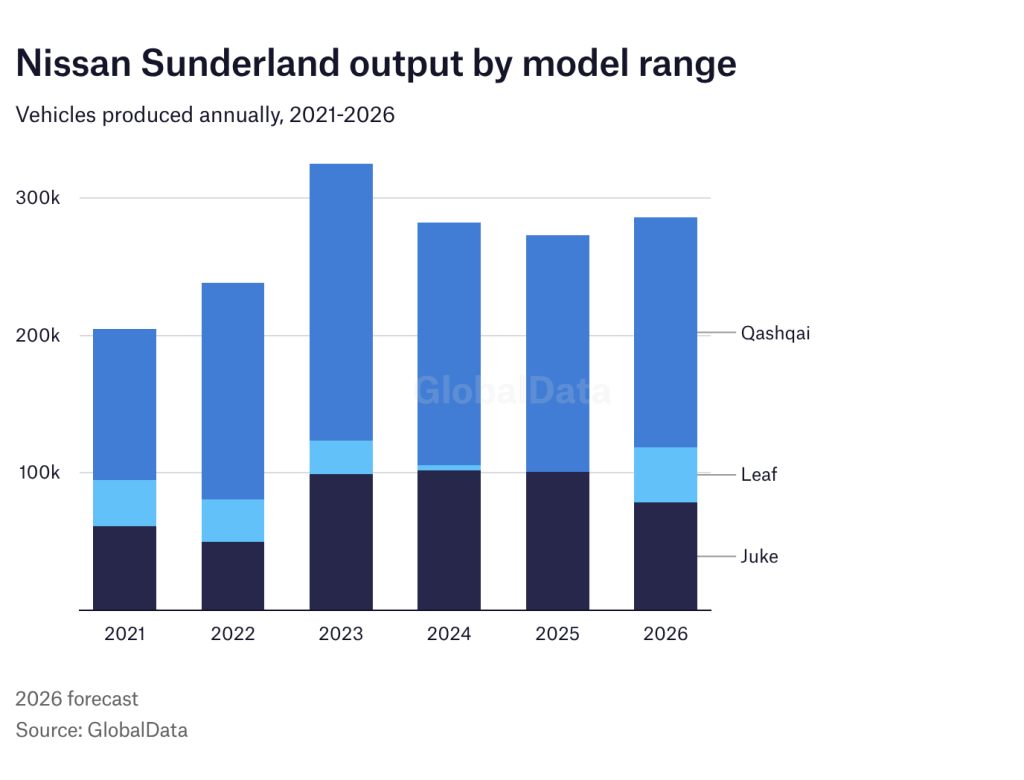
Sunderland is Nissan’s only remaining European assembly plant and employs around 6,000 workers in north-east England.
The Society of Motor Manufacturers and Traders (SMMT) said the factory produced more than 35% of all cars made in Britain last year, making it the country’s largest car plant.
The anticipated announcement is expected to align with the UK government’s confirmation of planned changes to its zero-emission vehicle mandate, which remains under consultation.
Current rules require EVs to account for 33% of a carmaker’s UK new car sales in 2026 and 80% by 2030.
The industry is seeking a reduction of the 2030 figure from 80% to 50%, while year-to-date UK BEV sales stand at just under 24% of new car sales.
Reuters’ sources said proposed changes would give Nissan more flexibility to build hybrid vehicles at Sunderland.
One source cited in the report said representatives of the UK government and Nissan met in London last weekend during Japanese Prime Minister Sanae Takaichi’s visit to the UK.
In April, Nissan chief executive Ivan Espinosa set out plans for a new electric Juke SUV at Sunderland and said the company would expand powertrain options across its model range.
Earlier this month, Nissan also said it had signed a memorandum of understanding with China's Chery to examine making Chery vehicles on one of Sunderland’s two production lines.
Nissan declined to comment on the talks but told the publication that it had “a strong and collaborative relationship with the UK government”.
A UK government spokesperson declined to comment and described Nissan as “an important and long-standing partner”, adding that Britain remained committed to its ZEV mandate while keeping it under review to ensure “a pragmatic and balanced approach”.