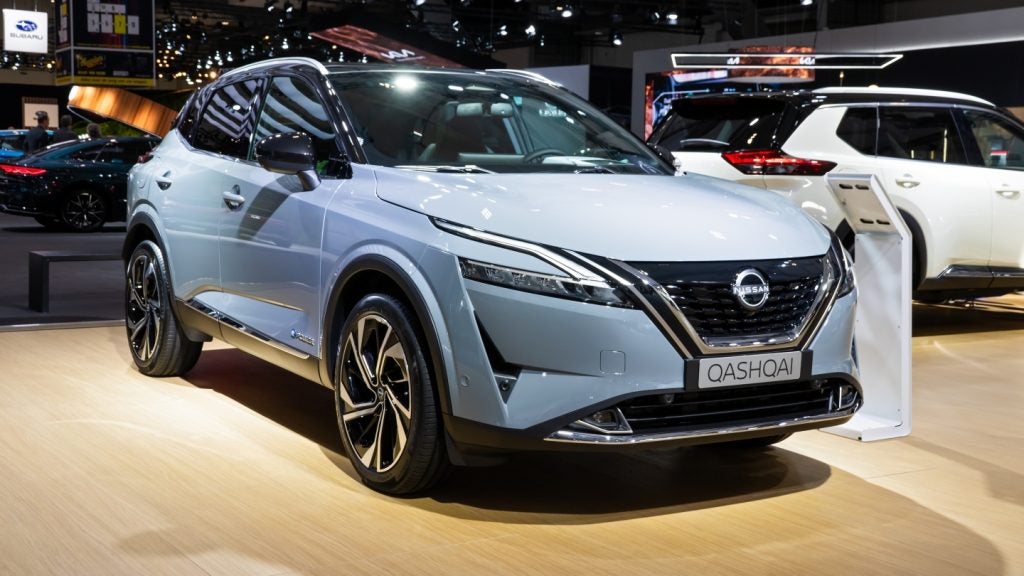
Nissan has reportedly abandoned plans to develop a fully electric version of the Qashqai, its best-performing European model, as part of a broader cost-cutting and rationalisation effort.
Citing unnamed sources, Reuters reported that development of the battery-electric variant was quietly wound down early last year.
The Qashqai is central to Nissan's European business, accounting for roughly 45% of the carmaker's total regional sales of 330,000 vehicles in 2025.
The Japanese carmaker had pledged in 2023 to manufacture an electric Qashqai at its Sunderland facility – UK's largest car plant – a commitment the UK government had highlighted as evidence of the country's standing as a global EV manufacturing hub.
No delivery timeline for the electric variant had been set at the time.
Should the project be revived, two of the sources said the vehicle would not reach market until the early 2030s.
Nissan did not directly comment to the publication on its plans for a fully electric Qashqai, but said it was still committed to broadening its “electrified” range, including hybrid models.
The company also cited “significant volatility” in European EV demand, adding that it was pursuing a “balanced” electrification strategy.
The Sunderland plant, which employs around 6,000 people in England's north-east, currently produces the electric Leaf compact.
In April, the carmaker unveiled an electric version of the Juke crossover SUV, also earmarked for production at the site.
Earlier this month, Nissan signed a pact with Chinese carmaker Chery to study the use of one of the plant's two production lines to build Chery vehicles.
Nissan is in ongoing discussions with the UK government over financial support for an updated Sunderland roadmap, with an announcement expected within the coming months.
The UK is separately consulting carmakers on proposals to ease EV sales targets that currently carry punitive fines for non-compliance – a move that could give Nissan additional room to produce hybrid vehicles at the facility.
According to the report, the decision forms part of a wider overhaul of Nissan's global model range.
The company has already confirmed it will not proceed with plans to build two electric SUVs at its Canton, Mississippi plant, pivoting instead to hybrid production, and has said it will reduce its total model count from 56 to 45.
A plan to produce a three-in-one EV powertrain at Sunderland through Nissan subsidiary JATCO has also been scrapped.
The shift comes amid growing regulatory uncertainty for UK-based manufacturers.
Proposed EU rules on local content requirements for EVs have added further complexity for British production, with approximately 60% of cars built in the UK exported to European markets.