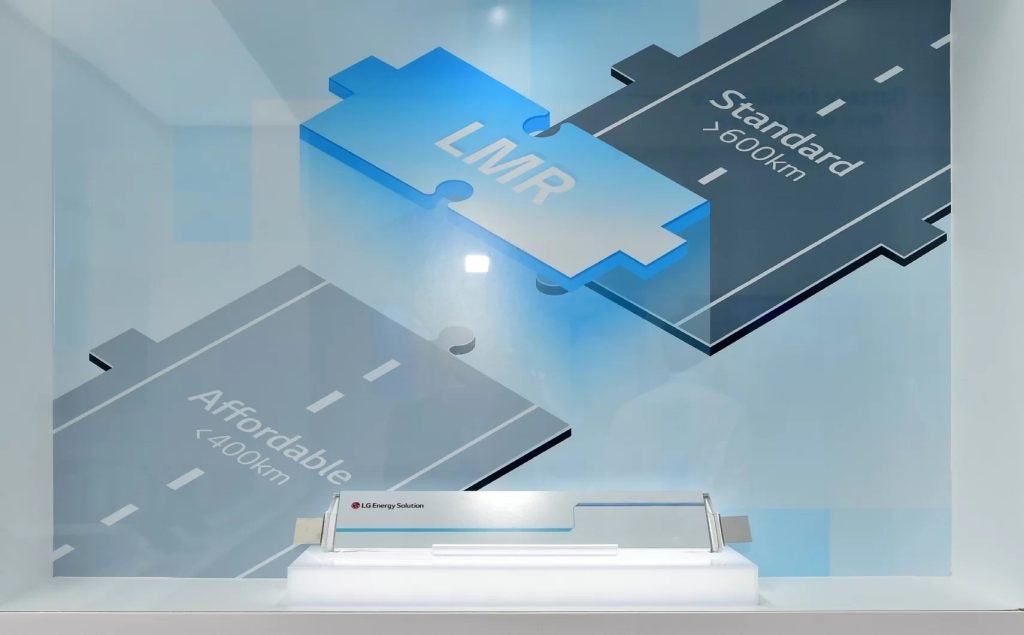
LG Energy Solution (LGES) announced that, in partnership with Seoul National University, it has developed a key technology that can significantly improve the stability of next-generation lithium manganese-rich (LMR) batteries – paving the way for the commercialisation of LMR materials in large-format cells used in electric vehicles (EVs).
The South Korean battery manufacturer confirmed that the joint research team has identified how to suppress gas generation and the resulting capacity degradation in LMR batteries during charging and discharging, overcoming what the company regards as the main challenge to the commercialisation of these batteries, adding that it “has developed optimal operating conditions for large-format cells to control these issues.”
LGES said it sees LMR as a next-generation cathode material that can lower material costs by using lower-cost manganese as a primary material, eliminating the need for cobalt, adding that LMR cathodes “can achieve high energy density by storing energy through both transition metals, such as nickel and manganese, and oxygen, in the cathode material.”
The company pointed out that "if oxygen that has oxidised during charging does not fully return to its original state during discharge, it can damage the battery’s internal structure and generate gas. In large-format cells for EVs, where available internal space is limited, this can increase internal pressure and degrade performance. As a result, gas generation has been a key challenge in commercializing LMR batteries.”
LGES noted that the joint research team analyzed oxygen redox under different charging and discharging conditions and found that oxygen recovery depends on both the upper cutoff voltage during charging and the discharge cutoff voltage during discharge. It said that “in testing, lowering the upper charging voltage from 4.6 V to 4.3 V increased the reduction of oxidized oxygen from 86% to 97%. The team also confirmed that lowering the discharge cutoff voltage from the conventional 3.0 V to 2.0 V enabled oxygen to recover to nearly its original state.”
Based on these findings, LGES researchers redesigned the operating voltage range and formation process conditions for 40 Ah-class large-format LMR cells. They applied a lower-temperature formation process to effectively suppress gas generation associated with large-format cells. The optimized 40 Ah-class large-format LMR cells retained 92.2% of their initial energy even after 883 charge-discharge cycles.
LGES said that “this outstanding cycle-life stability opens the path for the commercialisation of LMR materials in large-format cells for EVs, expanding their potential beyond small-format applications.
Professor Jongwoo Lim of Seoul National University said in a statement: “This study identified the causes of degradation in LMR batteries from the perspective of oxygen reversibility and demonstrated that cell stability can be improved through electrochemical protocol design alone. We confirmed that achieving long-term stability in LMR batteries requires comprehensive consideration of not only charging conditions but also discharge conditions.”
An LG Energy Solution spokesperson added: “This research addresses one of the key challenges facing LMR batteries. It demonstrates that stable battery life can be secured even in large-format cells by effectively suppressing gas generation, providing an important foundation for growth in the next-generation LMR battery market.”