The Japan Automobile Manufacturers Association (JAMA) has provided an updated seven-point priority list to help strengthen the country’s automotive and transportation industry. The Tokyo-based auto industry trade association has issued the policy priorities as it faces up to rising social and environmental challenges, as well as the rapid introduction of new technologies.
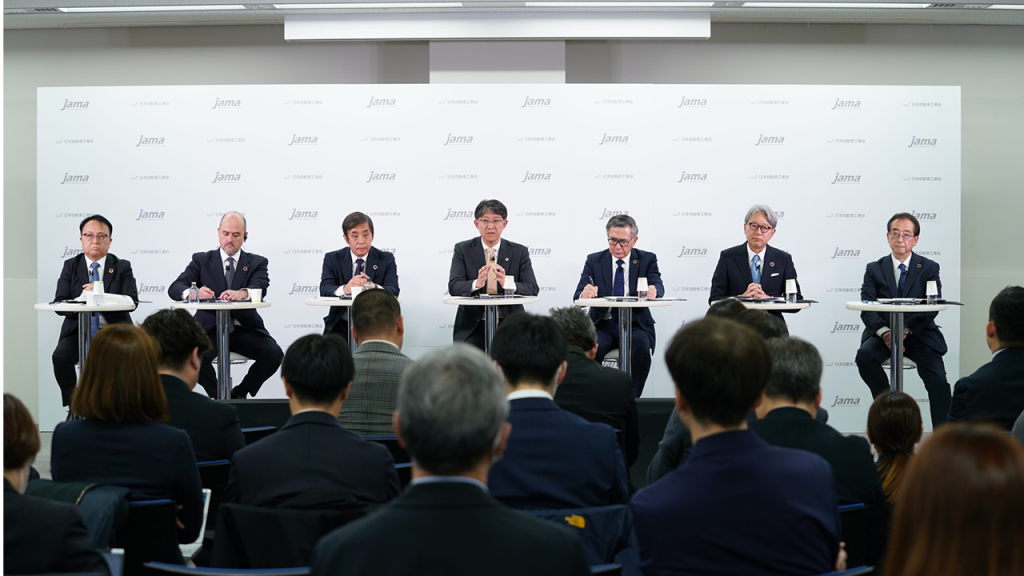
JAMA held its first press conference under the chairmanship of former Toyota Motor Corporation CEO, Koji Sato, in March. Before stepping down as CEO of Toyota last year, Koji Sato warned that major changes were needed for the automotive industry to stay competitive in a rapidly changing global environment, particularly within the country’s supply chain.
JAMA pointed out that Japan’s automotive industry “has made steady progress in areas such as environmental initiatives, safety, and technological innovation. However, challenges continue to accumulate, and a model driven solely by competition among individual companies is no longer sufficient. The question now is whether the industry can maintain its global competitiveness under the current model.”
The seven priority areas that JAMA outlined at its recent press conference include:
- Secure stable procurement of critical resources and components to minimize production stoppages, calling for members to mitigate risk by implementing an industry-wide response and building mechanisms that secure uninterrupted supplies.
- The association is also calling on members to work together to implement “multi-pathway” solutions towards achieving carbon neutrality by 2050. Key priorities include:
- establishing a supply and demand ecosystem that supports the widespread deployment of hydrogen-powered trucks for long-haul transportation.
- introducing dynamic wireless charging for electrified vehicles,
promoting E10 fuel adoption and accelerate the introduction of E20 carbon-neutral fuels. - Build mechanisms for the circular economy, including systems for parts and resource circulation to enhance economic security and environmental sustainability:
- implementing a viable domestic battery recycling industry, including establishing a second-life battery market. - Strengthen human resource foundations, including building systems that ensure the continuous recruitment and development of talent to support stable R&D, production, sales and services.
- Create transportation systems that integrate automated driving, combining people, vehicles and infrastructure to achieve safe and secure mobility, including:
- redesigning local transportation based on the integration of automated driving,
- standardizing transportation infrastructure systems. - Promote fundamental reform of automobile-related tax systems to establish a simpler, less onerous, and more user-acceptable tax framework:
- simplifying and streamlining automotive-related taxation,
- reducing the overall automotive tax burden. - Rebuild the automotive supply chain to enhance competitiveness and increase on-site capacities in relation to increased electrification, “intelligentisation”, and labour shortages:
- accumulating cargo and transportation data on a shared platform to further expand collaborative logistics and improve logistics efficiency,
- improve supply chain productivity and resilience by standardizing components and materials.