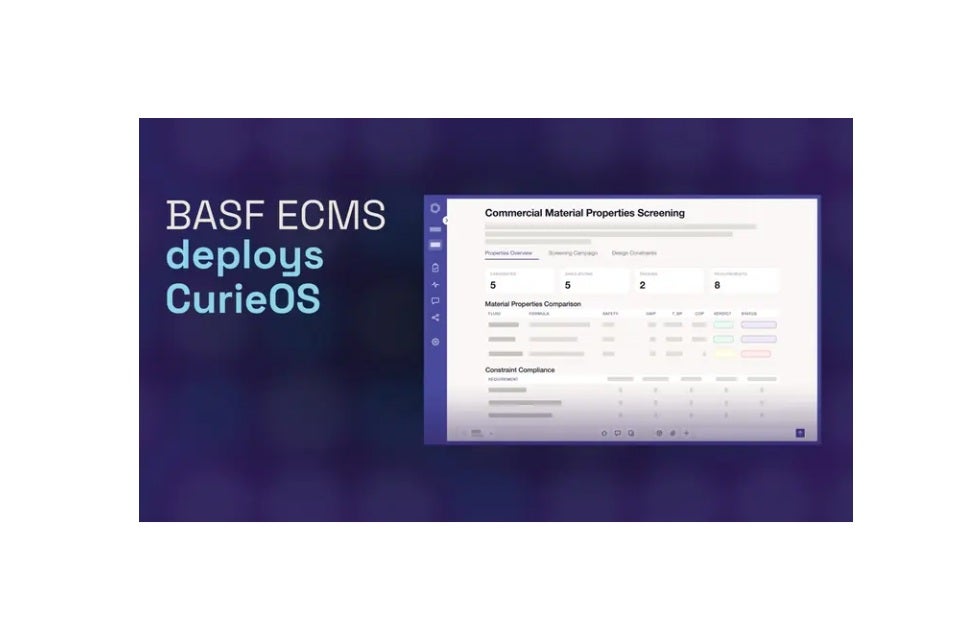
Orbital Industries, the AI industrial company, has announced an agreement with BASF Environmental Catalyst and Metal Solutions (ECMS) to license CurieOS, its proprietary AI platform for materials discovery.
CurieOS was previously used to develop a PFAS-free cooling material for Orbital IT. Under this new agreement, ECMS will deploy the platform to advance catalyst innovation for automotive emissions applications.
Traditional materials discovery involves time-consuming laboratory experiments where each candidate must be ‘synthesized, characterized, and tested’ — a process taking weeks per formulation and years per campaign. CurieOS accelerates this by using AI to identify promising materials before lab synthesis begins.
The platform functions as an AI research partner enabling scientists to provide multi-step, goal-driven instructions. It surveys scientific literature, analyses experimental data, and runs simulations to generate hypotheses rapidly. CurieOS’s core tool, Orb, is an AI-accelerated simulation model predicting properties of entirely new materials, functioning as a “Virtual Lab” that condenses months of physical testing into hours.
Orb represents a technological breakthrough — it is the only model capable of simulating 100,000 atoms on a single GPU and runs ten times faster than competing alternatives from Microsoft and Meta, transforming week-long quantum simulations into brief computations. Independent benchmarks confirm its predictions remain stable without drift or hallucinations, ensuring scientists can rely on results.
Saeed Alerasool, BASF Senior Vice President and Chief Technology Officer for ECMS said: “The agreement comes at a critical time for the automotive sector. The development of mobile emissions catalyst technologies continues to be driven by tightening emissions regulations, evolving powertrain technologies and alternative fuels, as well as growing cost pressure. At BASF ECMS, we continuously explore new approaches to the need to accelerate development and further improve R&D and application efficiency. Through this agreement, we look forward to leveraging emerging AI technologies to enhance our ability to deliver leading solutions and help address evolving customer and market needs.”
James Gin-Pollock, Chief Technology Officer of Orbital Industries, said: “Catalysis is a brutal test for any simulation model – you’re dealing with complex surfaces, large systems, and subtle interactions that cheaper methods miss. Orb was built for exactly this: it can simulate systems of a scale and complexity that were previously out of reach, fast enough that scientists can actually iterate. That’s what makes it valuable for real industrial workflows rather than just a research demo.”
Jonathan Godwin, Chief Executive Officer of Orbital Industries added: “The hardest part of materials discovery is knowing where to look. CurieOS gives scientists a way to explore and test ideas computationally before committing time in the lab, which means more of their effort goes into the candidates that matter. ECMS hosts exactly the kind of demanding, real-world materials development we built this for.”
About Orbital Industries
Orbital Industries describes itself as an AI-first industrial company ‘building hardware from the atoms up’. It says its goal is to lead an ‘industrial renaissance to advance critical technologies and secure our planet for generations to come’.
Every Orbital Industries product is invented using its proprietary AI platform, ‘uniting AI-automated hardware engineering with AI-designed material science to achieve breakthrough real-world performance’.