Automotive manufacturers and key supply chain companies are accelerating investment in robotics and automation as they seek to remain competitive, control costs and address ongoing workforce and energy pressures, according to ABB Robotics’ latest Automotive Manufacturing Outlook Survey.
“The intelligent factory is no longer a future ambition – it has become essential for manufacturers looking to stay competitive in a challenging and fast-moving environment,” said Joerg Reger, Managing Director of ABB Robotics Automotive Business Line. “This year’s survey shows that automation, particularly more autonomous and versatile robotics (AVR™), are increasingly viewed as a practical, near-term solution to cost pressures, labor availability and energy efficiency challenges.”
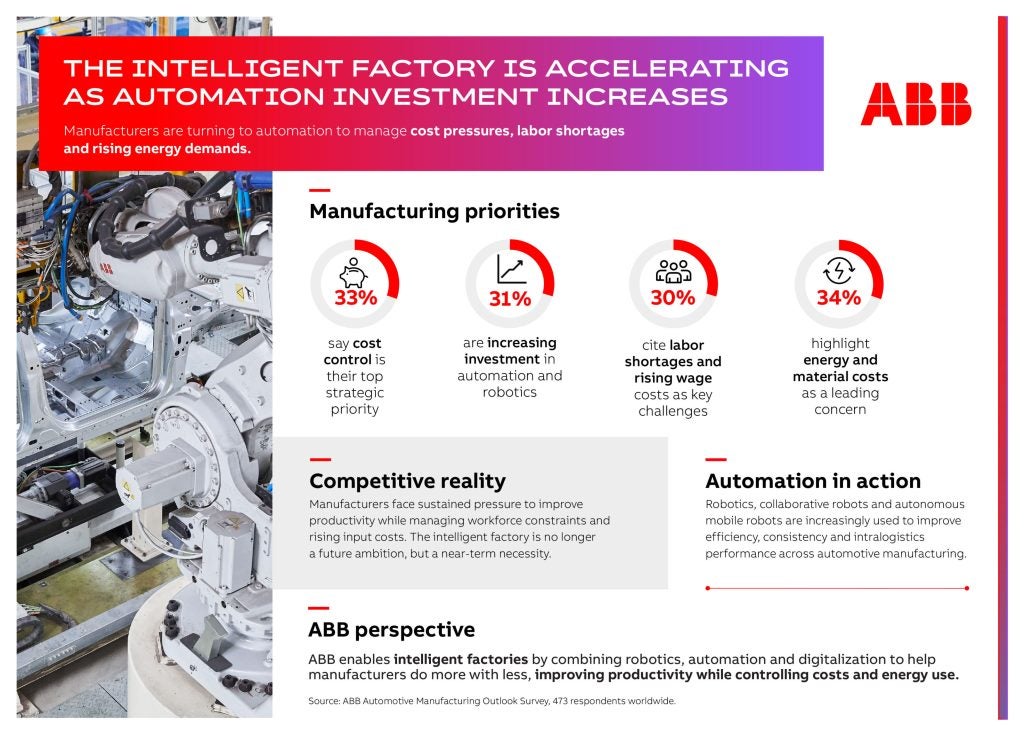
The global survey highlights how competitive pressures continue to shape manufacturing strategy across the automotive sector. Improving cost control and tighter budget management emerged as the single most important strategic priority, cited by 33% of respondents, reflecting the need to deliver productivity gains while managing rising input costs.
Workforce pressures remain a major factor. Three-in-ten respondents (30%) ranked labour shortages and rising wage costs among their most significant challenges, while skills availability continues to constrain production planning and operational flexibility in many regions.
At the same time, energy and material costs remain a critical concern, cited by 34% of manufacturers, reinforcing the need for more efficient production processes and smarter use of resources on the factory floor.
In response, manufacturers are increasingly turning to robotics, automation and autonomous material-handling solutions as a means of improving productivity, efficiency and resilience. Nearly one-third of respondents (31%) identified increased investment in automation and robotics as a key strategy for the year ahead, underlining the role of intelligent automation in addressing multiple pressures simultaneously.
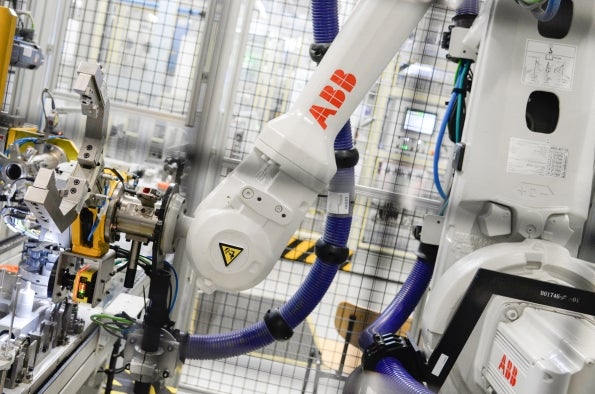
The survey also highlights growing interest in a wider range of automation technologies. Collaborative robots (cobots) are seen as well suited to repetitive and time-consuming assembly tasks, working safely alongside human operators to improve consistency and throughput.
Meanwhile, autonomous mobile robots (AMRs) and automated guided vehicles (AGVs) are increasingly valued for their ability to move parts and materials more safely and efficiently, helping reduce manual handling and streamline intralogistics.
These trends reflect a broader shift toward intelligent factories built around more autonomous and versatile robotics (AVR), enabling manufacturers to respond faster to cost, labour and energy pressures while maintaining productivity and resilience.
“Manufacturers are investing more selectively and more intelligently in automation,” added Reger. “Energy-efficient robots, flexible automation cells, cobots and autonomous mobile robots all play a role in helping factories do more with less – increasing productivity while keeping costs and energy consumption under control.”
As competitive pressures continue to intensify, the survey findings suggest that intelligent, automation-led manufacturing is moving firmly into the fast lane, becoming a central pillar of automotive production strategies worldwide.
This year’s ABB survey gathered insights from 473 automotive industry decision-makers representing vehicle manufacturers and suppliers across the value chain worldwide.