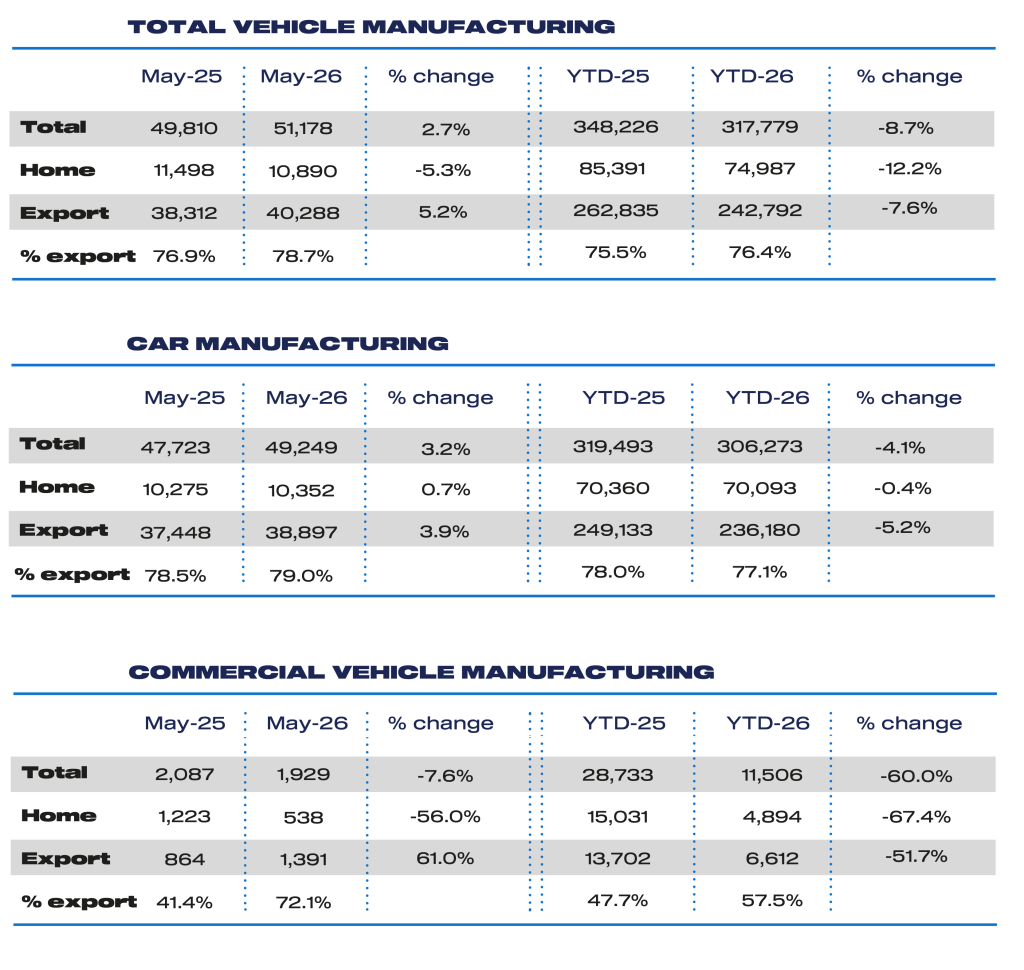
UK vehicle production rose 2.7% in May to 51,178 units, according to the latest figures published today by the Society of Motor Manufacturers and Traders (SMMT). Car output grew 3.2% to 49,249 units, reversing four months of decline, while commercial vehicle (CV) volumes fell 7.6% to 1,929 units.
Go deeper with GlobalData


Discover B2B Marketing That Performs
Combine business intelligence and editorial excellence to reach engaged professionals across 36 leading media platforms.
The stronger overall performance was driven by overseas orders, which recovered following a 30.3% decline in May last year when US tariff uncertainty pushed volumes to the lowest level since Covid-hit 2020. Car exports rose 3.9% to 38,897 units, while CV shipments increased 61.0% to 1,391 units, delivering an overall 5.2% outbound trade boost. Car production for the UK market was broadly stable, up 0.7% to 10,352 units, while CV output for UK buyers fell 56.0% to 538 units.
Among the top car export markets, the US was the strongest performer, with shipments up 83.1% to 7,733 units, reflecting the US-UK trade deal that came into force in June 2025. Exports to the EU fell 5.2% to 20,057 units, while those to China were down 14.3% to 2,794 units.
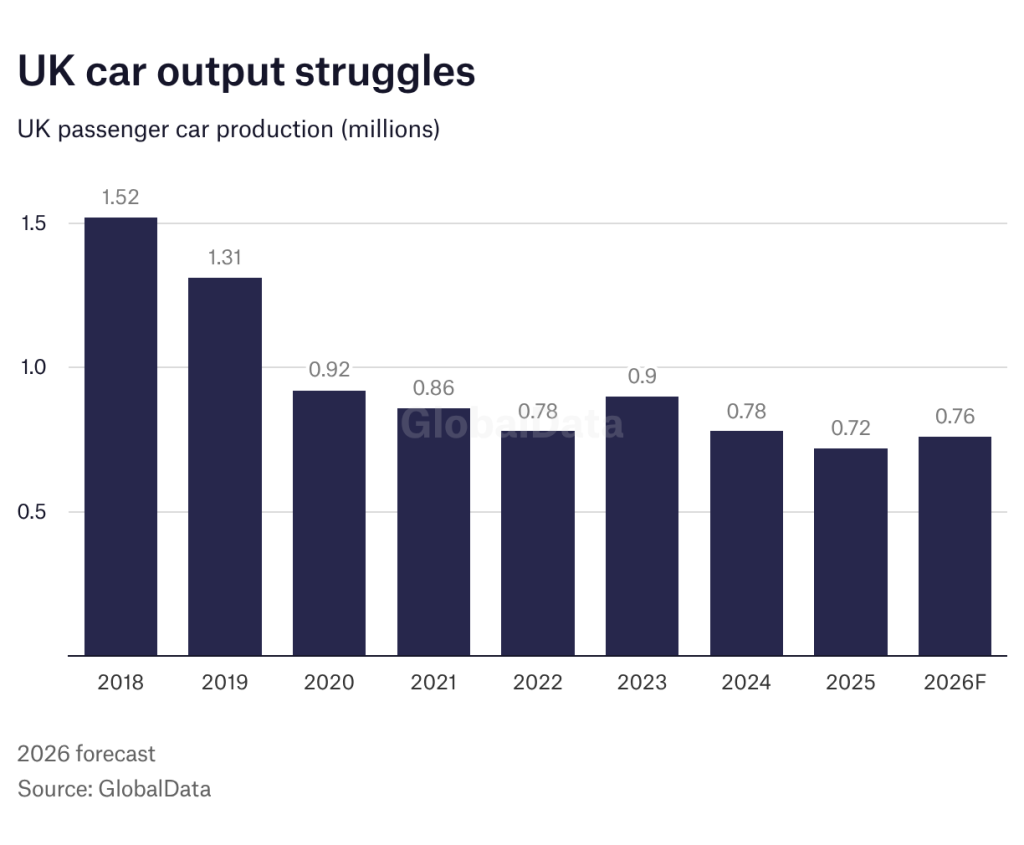
In the first five months of the year, UK car output is 4.1% down on last year, at 319,000 units. According to GlobalData analysis, the UK car industry is struggling to recover to pre-pandemic activity levels and is forecast at under 800,000 units of output for the whole of this year.
Mike Hawes, SMMT Chief Executive, said: “May’s growth is welcome, and the priority must be to turn this into a sustained recovery by making the UK more competitive as a place to make and sell vehicles. That means reducing industrial costs, maintaining free and open trade with the EU, and ensuring the ZEV mandate reflects market reality. Manufacturers are investing billions in zero emission technology, but weak underlying demand and the growing cost of compliance are putting competitiveness, jobs and future investment at risk. A mandate aligned with real-word conditions would support decarbonisation, strengthen the market, and help unlock the investment needed for long-term economic growth.”