
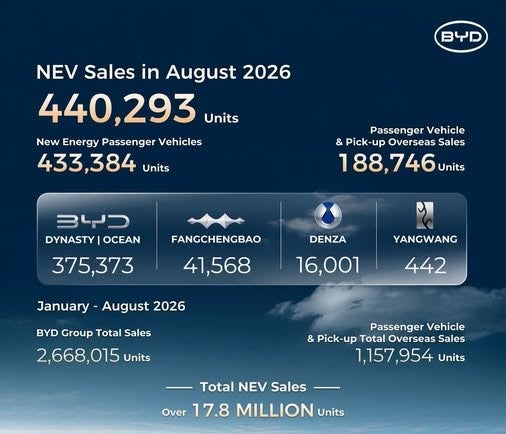
China’s largest new energy vehicle (NEV) manufacturer BYD Auto reported an 18% rise in global sales to 440,293 units in August 2026, marking the fourth consecutive month of growth for the company following eight months of declines. Last month’s growth followed a 22% surge in July, as overseas sales continued to strengthen – offsetting continued weak demand and fast-rising competition in its home market.
Domestic sales fell by 14% year-on-year to 250,827 units in August, while overseas sales surged by 134% to 189,466 vehicles, accounting for 43% of the company’s global sales.
Go deeper with GlobalData


Discover B2B Marketing That Performs
Combine business intelligence and editorial excellence to reach engaged professionals across 36 leading media platforms.
In the first eight months of 2026, BYD sold a total of 2,668,015 vehicles globally, down by almost 7% from last year’s 2,863,876 units, with domestic sales plunging by 33% to 1,505,755 units from 2,233,148 units in the same period last year. Overseas sales surged by 86% to 1,162,260 units year-to-date, after growing by 130% to 630,728 units previously.
BYD is in the process of switching its products to its second-generation Blade Battery, which features flash charging capabilities. The transition has caused some production bottlenecks in recent months, according to local reports. The company is also expanding its presence in the premium BEV segment, with the launch of the Dynasty Da Tang D-segment flagship SUV in July.
BYD has set a target of further increasing its overseas sales to 2.5 million vehicles in 2027, up from an expected 2.0 million units in 2026, helped by an expanded shipping fleet and rising production abroad, with the company’s plant in Hungary scheduled to become operational in the fourth quarter of 2026.




