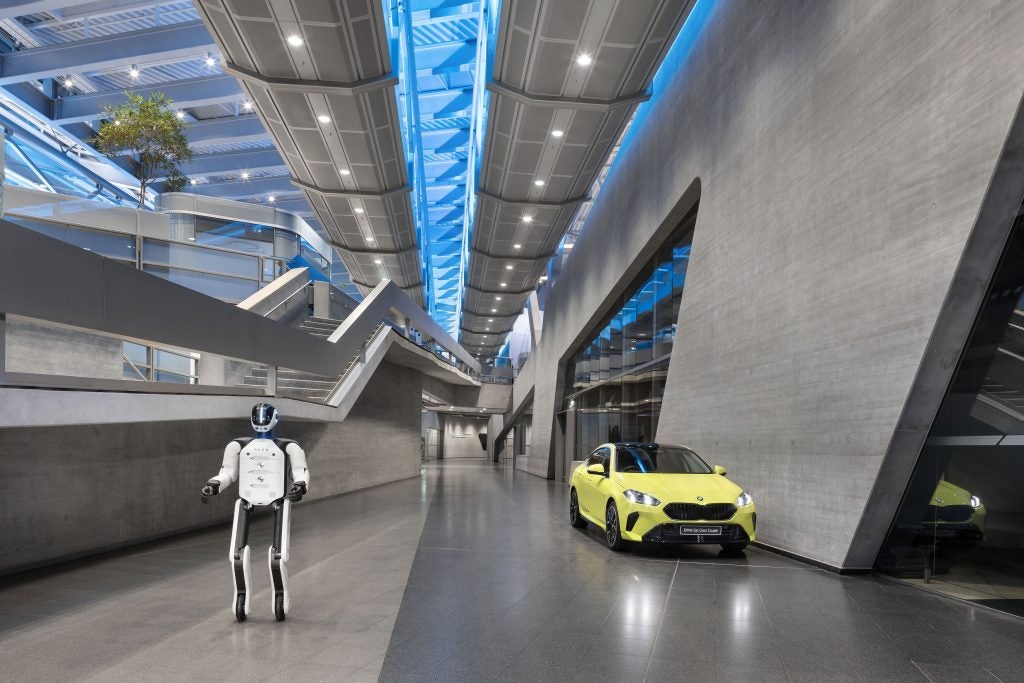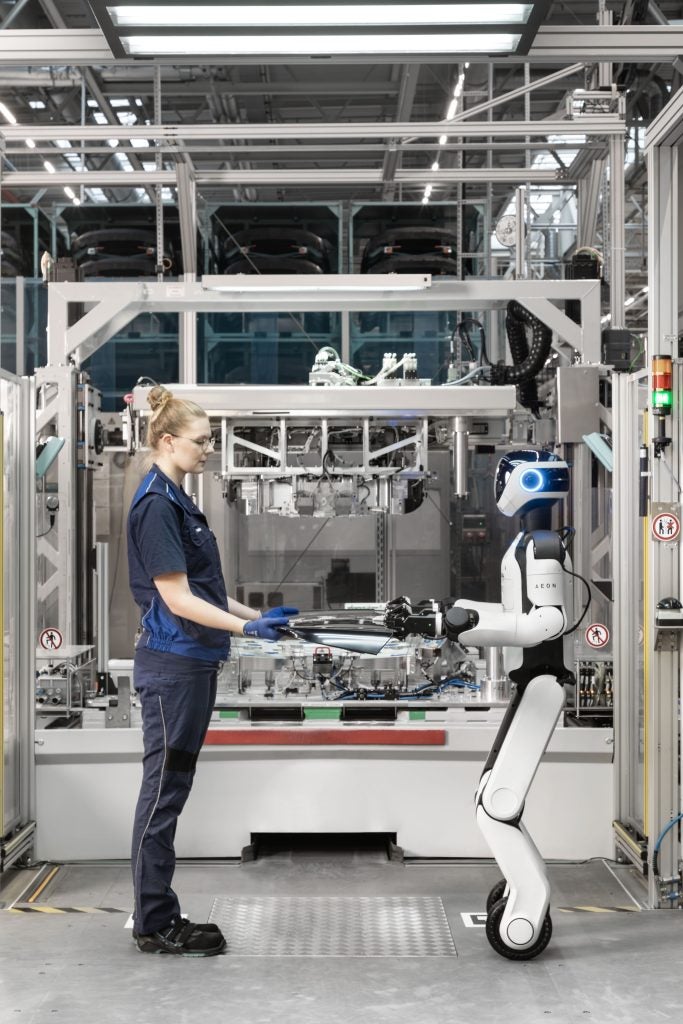
For the first time, the BMW Group says it is bringing ‘Physical AI’ to Europe and launching a pilot project with humanoid robots at its Leipzig, Germany, plant. The project aims to integrate humanoid robotics into existing series production of cars and to explore further applications in the production of batteries and components.
“Digitalisation improves the competitiveness of our production – here in Europe and worldwide. The symbiosis of engineering expertise and artificial intelligence opens up entirely new possibilities in production,” said Milan Nedeljković, Member of the Board of Management of BMW AG, Production.
Last year, the BMW Group successfully implemented a pilot project with humanoid robots at its Spartanburg plant in the United States. The insights gained from this project are being leveraged to further develop and scale Physical AI applications, the ocnmpany says.
Unified IT and data model in the production system
BMW points out that artificial intelligence is already an integral part of the BMW Group’s production system. From the virtual factory with digital twins and AI‑enabled quality controls to intralogistics with autonomous transport solutions, intelligent systems are used in almost all production steps, BMW says.
A prerequisite for the effective use of artificial intelligence in production is a unified IT and data model across the entire production system. The BMW Group has consistently transformed isolated data silos into a unified data platform in its production system meaning that all data is consistent, standardised, and available at all times. This enables digital AI agents to take on increasingly challenging tasks autonomously and in complex environments while continuously learning and becoming available for additional areas of application. The introduction of intelligent and autonomous decision‑making agents marks a paradigm shift in production, according to BMW. In combination with robots, these digital AI agents are what make up Physical AI.
“Our aim is to be a technology leader and to integrate new technologies into production at an early stage. Pilot projects help us to test and further develop the use of Physical AI – that is, AI‑enabled robots capable of learning – under real-world industrial conditions,” said Michael Nikolaides, Senior Vice President Production Network, Supply Chain Management at BMW Group.
Digitalisation and artificial intelligence are core elements of BMW iFACTORY and are the foundation for future‑proof, flexible, and competitive production.
Humanoid robotics complements existing automation
The BMW Group is strategically expanding its automation portfolio to include Physical AI and humanoid robotics. Humanoid robots are viewed as a value‑adding complement to existing automation. Particularly, they demonstrate potential in monotonous, ergonomically demanding, or safety‑critical tasks. The goal is to relieve employees and further improve working conditions.
First pilot project with humanoid robots in Europe
In collaboration with Hexagon, a long‑standing, established partner of the BMW Group in the field of sensor technology and software, the first pilot project in Europe is now underway. Hexagon’s organisational unit located in Zürich, Hexagon Robotics, specialises in Physical AI and presented its first humanoid robot, AEON, in June 2025. Following an initial theoretical evaluation phase and successful laboratory tests, there was an initial test deployment at BMW Group Plant Leipzig in December 2025. A further test deployment is planned from April 2026 to ensure full integration for the actual pilot phase starting in summer 2026.
The deployment in Leipzig is focusing on testing a multifunctional application of the robot. It is based on AEON’s design, whose human‑like body allows a wide range of hand and gripper elements or scanning tools to be flexibly attached and enables dynamic use on wheels. During testing and later in the pilot phase, the robot will be used in the assembly of high‑voltage batteries and in component manufacturing.
Successful pilot at BMW Group Plant Spartanburg provides key insights for use of humanoid robots in production
The world’s first deployment of humanoid robots at a BMW Group plant took place at the Spartanburg plant in the United States in 2025, in collaboration with the technology company Figure AI. The results demonstrated that Physical AI can deliver measurable added value under real-world conditions. Within ten months, the robot Figure 02 supported the production of more than 30,000 BMW X3, working ten-hour shifts daily from Monday to Friday. Figure 02 handled the precise removal and positioning of sheet metal parts for the welding process – a task that is particularly demanding in terms of speed and accuracy while also being physically exhausting. In total, it moved more than 90,000 components and covered approximately 1.2 million steps in around 1,250 operating hours.
The pilot confirmed that humanoid robots can safely perform precise, repetitive work steps – such as positioning components with millimetre precision – and provided important insights for the further deployment of Physical AI in production.
During the initial test phases with Figure 02, it was essential to involve all areas of the production IT infrastructure, occupational safety, production process management, and shop floor logistics at an early stage.
One key finding was that the transition from the laboratory to the actual production environment was faster than expected. Motion sequences trained in the laboratory could be quickly transferred into stable shift operation. To ensure smooth coexistence with existing systems, integration into the BMW Smart Robotics ecosystem was implemented via standardised interfaces.
The body shop was deliberately selected for the test phase in Spartanburg, as it already has a high degree of automation. BMW Group employees in this area have extensive experience in integrating new technologies and processes. For example, material supply on the line is already carried out almost exclusively via automated smart transport robots (STR). The project team’s early communication ensured transparency from the outset and promoted acceptance. The deployment of humanoid robots was met with great interest among employees and quickly became a natural part of everyday work during the course of the project.
The BMW Group and Figure are currently evaluating additional use cases for deploying the Figure 03 robot.