
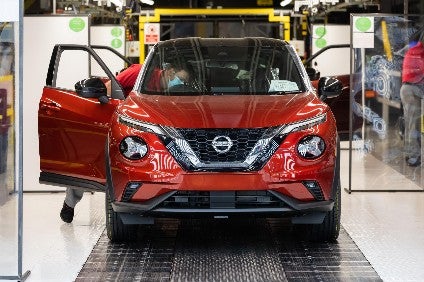
Nissan, despite some product hits in various markets over the last few years – Qashqai in Europe always comes to mind – has struggled of late as well as enduring the long-running Ghosn saga. Nissan said last week it would cut production at its three Japanese factories – Oppama, Tochigi and Kyushu – with new production suspensions planned on dates from 29 June through 31 July. This week, our analyst put the news under his microscope, concluding the cuts were “unsurprising”: “The latest move from Nissan reflects weak demand for Nissan products at home and in major export markets. It is unsurprising given how far demand has fallen due to the COVID-19 crisis. Global light vehicle sales fell 33.8% in May to 4.9m from 7.5m a year ago and in Japan, the vehicle market plunged 45% in May. GlobalData’s base COVID-19 light vehicle sales scenario forecasts a fall of 17.2% on 2019 to 73.7m sales in 2020. The hit to the market will be greater than the 2007/8 financial crisis.”
Unions have agreed that workers from PSA’s Vauxhall Astra plant at Ellesmere Port can transfer temporarily to the van plant at Luton – which makes PSA designed models for Vauxhall, Opel, Peugeot and Citroen. The automaker said demand for vans – think of all the extra home deliveries during the now-easing UK coronavirus lockdown – required three shifts at Luton plant. Ellesmere Port will restart operations after 1 September after much work now under way to reconfigure it to provide social distancing and other safety measures for employees to enable production to resume. So this temporary move to Luton gives furloughed Ellesmere Port volunteers (and some from a parts facility nearer Luton) work during the COVID-19 crisis. Good news, for once. Only 810 commercial vehicles were built in the UK in May, down 61.6% year on year, as many plants remain shuttered. Luton has since gotten going again but social distancing measures affect productivity.
Go deeper with GlobalData


Access deeper industry intelligence
Experience unmatched clarity with a single platform that combines unique data, AI, and human expertise.
When will autonomous vehicles go beyond Level 3? That’s a question our technology analyst addressed this week. Despite some bold predictions for autonomous vehicles (AVs) over the past few years, enthusiasm and investment for further development has stalled lately. While we are seeing an acceleration of level 1 and 2 driving automation, there are delays in higher levels due to the lack of an established regulatory framework and the Herculean challenge of providing safety in all driving situations. Well worth a read.
BMW Group and Mercedes-Benz are putting their cooperation on development of next-generation technology for automated driving temporarily on hold. Following extensive review, the two companies said they had arrived at a ‘mutual and amicable agreement to concentrate on their existing development paths – which may also include working with current or new partners’. The two companies cited the cost of developing a new next generation shared autonomous drive technology platform, as well as current business and economic conditions, as reasons for putting the cooperation on hold. They also both made it clear that they want to stay strategically flexible as they view the post-Covid future, with all its uncertainties.
BMW and its German works council have agreed a package of personnel measures which offers early retirement severance packages, longer holidays and reduced contract hours. The automaker said the move “balances the future competitiveness of the company with the interests of the workforce”. The new package consists of four measures affecting mainly Germany.
Battery manufacturer, Britishvolt has appointed Charles Morgan to the advisory board and board of directors. Morgan, whose grandfather founded British brand, Morgan, in 1909, became a founding member of the government-backed Automotive Council Advisory in 2010, as well as serving on the executive board at the Society of Motor Manufacturers and Traders (SMMT), for nine years.
Our new and future models analyst has been busy again this week and it was the turn of Daimler’s Mercedes-Benz: Will Mercedes-Benz ever cease expanding its range of SUVs? Or rather, why would Daimler stop launching ever more plus replacement models when there seems to be seemingly limitless demand in many markets? What IS changing is the fuel efficiency of such vehicles, and there is much innovation yet to come as China and Europe’s fuel consumption and emissions legislation grows ever more stringent.
More good news: Mazda Motor announced it would resume both day and night shift operations, without suspensions, at all plants in Japan “before the end of July”. “Our plants in Mexico and Thailand will continue to operate with a reduced number of working days,” the automaker added. The automaker said its production volume in Japan during the last few months of COVID-19 related cut backs had been as low as 40% of output in the same months of 2019 but volume for July in Japan would recover to as much as 80% of output in July 2019.
Finally, the latest issue of the quarterly just-auto magazine (JAM) was out this week. As editor Dave Leggett said: “It’s digital not print, but we like to think it feels like a magazine and works as something a little bit different – in pace – from our website. It is another string to our bow and another way to keep you up-to-date with rapidly changing automotive trends and times – but in a manner that we hope is clear, informative and concise. We have a schedule of topical industry themes for each issue. In this issue (#6), we take a look at different aspects of automotive lightweighting, material use and sustainability. We can’t cover it all in the space available, but it is very refreshing to be reminded of just how much innovation, creativity, engineering and intelligent thought is being given to some of the great challenges of our time. Pull up a seat, grab a coffee and have a read (no registration required, just one click and you’re there).”
Have a great weekend.
Graeme Roberts, Deputy Editor, just-auto.com



