
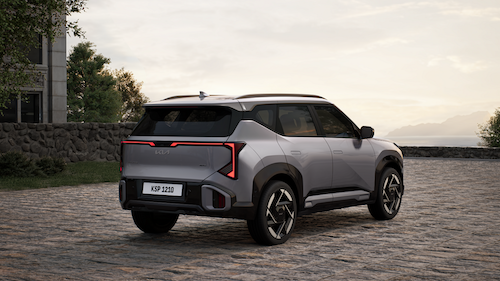
It has taken quite a hit from US tariffs and remains either ready to greatly benefit from having so many EVs or could be dangerously exposed as a result of having so many EVs: many big questions surround Kia’s future. The company certainly has a very large number of current models and with the exception of China, a good spread of major markets.
Cars – lots of them, still
Go deeper with GlobalData


Discover B2B Marketing That Performs
Combine business intelligence and editorial excellence to reach engaged professionals across 36 leading media platforms.
One of the fascinating things about both Kia and its major shareholder Hyundai Motor is just how many cars they produce. Rivals might have withdrawn from multiple segments, especially in the USA and Europe yet the Korean makes if anything keep adding new vehicle lines. And reaping the rewards.
Starting with the Picanto/Morning, this little hatchback is something of a star performer in Europe/South Korea. This has been greatly helped by other OEMs either withdrawing from the A segment or instead going all-in on EVs. Witness the disastrous move by Stellantis which failed to invest in successors for the once big-volume Lancia Ypsilon and Fiat 500.
It is believed that Kia plans to kill the Morning and Picanto in 2027, hoping that an EV1 will be just as successful. Such a model would also succeed the Ray, another A segment hatchback. Taller and with one sliding side door, is also available as an EV.
K3, K4…
The K series cars still exist though certain numbers remain missing. Now the global line-up starts with the K3, a China-specific sedan which has not been a success. Nor has the K4, also known as the Forte Furuidi. It is equally aged and likely for the chop later this year.
Another, larger K4 is by contrast new and off to a good start in the USA. Revealed in March 2024, it debuted a few days later at the New York auto show as a replacement for North America’s Cerato/Forte replacement. Built in Mexico and also exported to Canada, the Middle East and Latin America, the 4,709 mm long K4 is big for the Compact class. There is also a shorter hatchback (it also replaced the Ceed), and in Europe, a wagon. All should be in production for seven years with a facelift in 2028/2029.
…K5, K6, K7, K8, K9
The larger K5 is made in both China, where it does not do too well, and South Korea where it fares better: 36,598 were sold in the ROK in 2025. A major facelift is due to happen later in 2026. Some believe the K5 will become larger, pricier and change names to K6. Build would then continue until 2030.
Rebodying and renaming the former K7 is what Kia did to create today’s K8. And that car is also due to be replaced relatively soon, probably in 2027. However, it seems unlikely that a new generation K9 will happen, registrations for this large sedan in the ROK numbering fewer than 1,600 for all of 2025. The K9 range was slashed to one high-end trim level in May 2025, a 3.8-litre V6 now being the only engine after the 3.3-litre turbo V6 and 5.0-litre V8 were dropped.
ICE SUVs
One of Kia’s smallest vehicles is the now year-old Syros, an SUV. Measuring a little less than four metres from end to end, it was developed mainly for India, which is also where it is manufactured. A facelift is expected in early 2028 and a successor in 2031.
By contrast, the slightly lengthier (4.1 m) Stonic, sold as the KX1 in China, is quite an elderly model. Now eight years old, it will be around for a while yet, a facelift having only been announced last September. Kia says build will keep going until 2028 though Korean production ended in 2023. The Stonic does best in certain European countries.
Above the Syros, Stonic/KX1 and in relevant markets, the just-facelifted Niro (4,355 mm long), sits the Seltos, a very successful vehicle. It is also one of the few Kias which has been well received by buyers in China, though the brand’s entire volume there last year was only 81,300 vehicles. Whether or not the newest generation ends up becoming available in the PRC is uncertain. For now, the previous model continues there. Rumours continue to suggest that Kia could leave China.
Seltos goes global
The latest shape, 4,430 mm long SP3 series Seltos comes with 1.6-litre turbo petrol, 2.0-litre atmo and 1.6-litre hybrid powertrains. It has just been launched in South Korea. Build is at Autoland Gwangju and in India too, at the Anantapur factory in Andhra Pradesh. Kia hopes to sell some 430,000 worldwide: 130,000 for North America and 60,000 for Europe with Oceania taking 30,000 and India 100,000. There is no official target volume for South Korea but that market should take the majority of the remainder.
The ProCeed, Ceed and Ceed SW are all now dead but the XCeed continues. In fact this 4.4 m long SUV will soon be given another facelift. That should mean it remains being built (Slovakia) until 2028 or even 2029.
Kia’s biggest seller is in the size segment or rather segments above all of these other SUVs. Segments plural is because the Sportage comes in two lengths, a shorter one being mainly for European countries – it is a very big seller in the UK for example. The long body model is, meanwhile, wildly popular in the USA having overtaken the (now-discontinued) Soul some years ago as Kia America’s number one vehicle. Both Sportages are due to be replaced by a sixth generation range in 2028.
MQ4, MQ4i and MQ5
Some might be surprised to learn that a relatively large SUV is not the number one model for the US market, and also that this same vehicle is a best seller in Korea. The Sorento not only holds that title but with 100,002 deliveries in the ROK for all of 2025, it was the number one vehicle, beating all Hyundais.
There has just been a small update and of note, the diesel engine continues, along with a 1.6-litre turbo hybrid and a 2.5-litre turbo (petrol). And while MQ5, the replacement, should arrive within the next 12 months, that will not apply in the Indian market. Instead, a special hybrid SUV (code: MQ4i) is due for launch there soon. The codename reveals that this will be based upon then fourth generation Sorento which was new for other markets back in 2020.
LQ2 will last into the 2030s
Kia’s largest liquid-fuel SUV is the Telluride. Way more successful than the similarly sized EV9 (see electric models below), it has just gone to a second generation. New for the USA’s 2027 model year, the LQ2 series edition is even bigger than before and powered by the choice of 2.5 turbo or 2.5 turbo hybrid powertrains.
Build of this BMW X7-sized model is again at KMMG, short for Kia’s West Point factory in Georgia (KMMG). It is believed that the Telluride 2 will not be available in South Korea. There should be a facelift in CY2029 and unless buyers preferences change by around that time, the third generation would again be petrol-powered. Such a vehicle would be due in the first quarter of 2032 for the 2033 model year.
EV1 to EV9 – too many electric models?
We should hear some specifics about possible forthcoming EVs at the company’s investors’ day in April. Will there be details of not only of the potential EV1 (due in 2027/2028?), a future twin of the proposed Hyundai Ioniq 1? And did the recent Vision Meta Turismo concept (see image) herald an EV7 or EV8 as an electric successor for the Stinger in 2028/2029? Each of those three numbers is ‘missing’ in the company’s electric cars/SUVs global line-up, which presently stretches from EV2 to EV9.
While some of the bigger models have not (yet?) taken off in their intended major markets, the smaller ones are doing better, especially in Europe, and surprisingly, South Korea too. There, the EV3 found 21,212 buyers in 2025 so perhaps things are changing for take-up of electric vehicles in general in Kia’s homeland.
Below the EV3 there will be an EV2 and probably an EV1. The 2, which is 4,060 mm long, is yet to enter production, having only just premiered at the Brussels motor show a few weeks ago. It is front-wheel drive and will offer buyers a choice of 42.2 kWh standard-range or 61 kWh long-range battery choices. Both four-seat and five-seat layouts will be available. Aimed mainly at European countries, this is the second EV to be built at the Žilina plant: the EV4 was the first.
No EV4 for America after all
Unlike many other electric Kias, the EV4 is a fastback sedan. However, it looks very different to another model with that body style, the K4, with highly unusual styling and proportions. It is built in both South Korea (Gwangmyeong EVO Plant, within Kia Autoland Gwangmyeong) and Žilina (Slovakia). Plans to offer it in the USA were suddenly cancelled last October. A mid-cycle facelift should take place during the second half of 2028, and the successor would be due in 2031 or 2032.
The EV5 has, alas, been a disappointment in China. This is a shame as the model, a 4.6 m long SUV, made its world debut in that country back in August 2023. Production for export markets commenced in April 2024, build taking place at the Yueda Kia 50-50 JV plant in Yancheng (Jiangsu).
Since last year, the EV5 has also been manufactured in Kia’s own Gwangju plant in South Korea. There will probably be a facelift in 2027 and a potential replacement in 2030. Much depends on demand for the current OV series model, especially in Europe.
Range extenders for future EVs?
One of Kia’s oldest electric SUVs is the EV6, which is however more of a sports crossover or coupe-SUV. It was facelifted in May 2024 and gained a new battery at the same time. Its successor is expected in 2027.
As mentioned above, the EV9 hasn’t sold in big numbers its debut in 2023. However, it is very expensive, something which is not often associated with Kias, so it could just be taking its time to gain traction. Nonetheless it is hard to see where the natural market for a huge, pricey electric Kia SUV would be; certainly not the USA as had once been (optimistically?) intended.
Adding an even faster, heavier and more costly GT doesn’t seem to have given the EV9 the sales boost it needs. So will it have a successor in 2030? Probably, but it could also be offered in range-extender form which might prove to be a better idea for multiple countries. And lowering pricing would certainly help too.




