
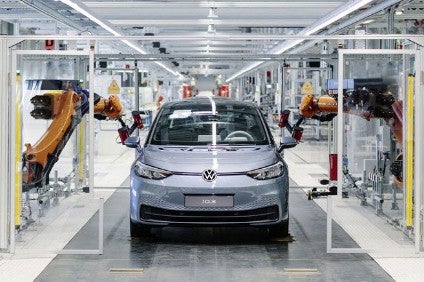
News that Volkswagen had begun what it termed its "system changeover to e-mobility" by celebrating the start of ID.3 production in Zwickau with an events attended by German chancellor Angela Merkel and, of course, group CEO Herbert Diess was the most-read article on just-auto this week.
As a deluge of recent press releases suggests, VW is serious about electrification. The group plans to sell 22m EVs worldwide by 2028 and is converting its entire Zwickau plant to make EVs and has already spent EUR1.2bn there. The plant is scheduled to build 100,000 electric models next year with output rising to 330,000 in 2021. The ID.3 is based on VW's Modular Electric Drive Toolkit (MEB) and the automaker claims a long range, spacious interior and dynamic vehicle handling for the new model priced from "under EUR30,000" in Germany. The ID.3 will be launched throughout Europe in summer 2020 with VW saying around 35,000 buyers have already reserved a car and paid a pre-booking deposit. Production is carbon-neutral and green power is exclusively used for energy-intensive battery cell production. Emissions from the entire production process that are currently unavoidable are offset.
Go deeper with GlobalData


Access deeper industry intelligence
Experience unmatched clarity with a single platform that combines unique data, AI, and human expertise.
I've yet to try one, let alone see one, but Suzuki's long awaited new Jimny has been a smash hit, at least with UK motoring writers. One of us has got lucky and opined: "Not even Suzuki's tiny Hustler SUV manages to look as tough and cute as the equally dinky Jimny. Whereas the former comes only in 660cc mini-vehicle form and is therefore hard to find outside Japan, 1.5-litre ladder-frame big brother is available in Britain, albeit via a long waiting list. So why aren't other car makers in this segment?" Read on to find out.
What did Callum do next? Created CALLUM after years at Jaguar Land Rover. As Matthew Beecham discovered, in a short space of time, legendary designer Ian Callum and his team at CALLUM formed a design studio and engineering workshop, recruited 18 experienced people and revealed their first project, the Vanquish 25 by CALLUM. He caught up with Ian to uncover more details of the Aston Martin, the background to the studio's offering and its plans.
Mention of JLR reminds me the British company (yes, I know it's Indian owned) is extremely innovative. 'See through Range Rover bonnet' anyone? The latest trick from the Gaydon skunkworks, and they're not alone in doing this, is printed electronics displays and colour changing interior panels. JLR this week said "pioneering structural electronics research" could see dashboards replaced by curved screens and allow drivers to customise interiors thanks to colour changing body panels. In a claimed world first, the automaker is developing Lightweight Electronics in Simplified Architecture (LESA) research technology – used in flexible wearables and curved OLED TVs – for car interiors. This, JLR said, has the potential to radically change cabins of the future and would offer customers greater ability to customise their cars to suit their needs. Using LESA technology, the automaker and its suppliers would will be able to manufacture body panel displays to show information only when needed to help designers achieve streamlined and buttonless designs for future cars. Such designs may include customisable interior ambient lighting systems, body controls, wrap around, no button dashboards and advanced fabric/leather heated steering wheels. The innovative printed electronics system would also reduce the weight of car electronics by up to 60% as wiring, sensors and computing are contained within all non-metal materials, removing the need for extra packaging space for control units.
Car sales worldwide are trending down, mostly, (see Japan October results) and this held true this week as our very own UK October tally was revealed. New car sales fell 6.7% in October, as the market continued to be hit by weak consumer and business confidence as economic and political uncertainty prevailed. Private consumer registrations were down 13.2% and business demand also fell, while fleet registrations remained stable. Registrations of diesel cars fell for the 31st consecutive month, down 28.3%, while petrol engined cars also declined, by 3.2%. Bucking the overall trend, electrified cars continued to grow in popularity. Hybrid electric cars increased by a considerable 28.9%, as battery electric vehicle registrations almost tripled, up 151.8%. Plug-in hybrids, however, fell just short of their positive performance in the same month last year, down 1.7%, as they continue to be hit by the withdrawal of purchase incentives by the government. Year to date, the new car market remained in decline, down 2.9%, as diesel, clean air zones (Bristol has recently proposed a blanket ban on private diesel cars in the city centre) and uncertainty over Brexit stunted economic growth.
On just-auto, you're never far away from a good, recent interview and, again Matt Beecham has been on the case. This week he noted Valeo Thermal Systems was on a mission to optimise thermal energy management for cleaner, safer and more reliable mobility, while redefining passenger well-being inside the cabin. To learn more about the big picture and forces driving the demanding automotive HVAC market, he spoke to Guillaume Devauchelle, vice president, innovation and scientific development, at Valeo Group.
While VW is starting ID.3 production, others are still revealing what they are going to make. Case in point: Fisker, which this week named its upcoming all electric, 'luxury sports utility vehicle' the Ocean. Fisker's Ocean, it was claimed, would be the world's most sustainable vehicle – featuring recycled, vegan and more innovative materials. The company reckons the future of mobility is about "enjoying an electric vehicle without hassle, long-term commitment and the prohibitive high cost of ownership". Hence the new EV will be offered with a flexible lease via a mobile app with service and maintenance included in the monthly. Happy days.
Have a nice weekend.
Graeme Roberts, Deputy Editor, just-auto.com



