
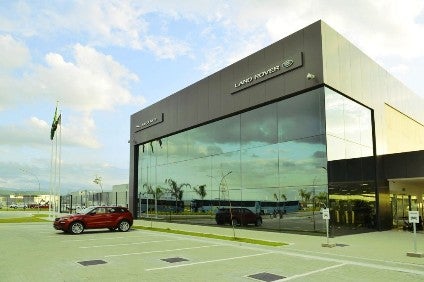
Despite production volumes way short of expectations, Jaguar Land Rover has no plans to close its Brazilian assembly plant, a top executive has said.
JLR opened the Brazilian plant in 2016 in the village of Itatiaia, 280km (175 miles) northwest of Rio de Janeiro.
Go deeper with GlobalData


Discover B2B Marketing That Performs
Combine business intelligence and editorial excellence to reach engaged professionals across 36 leading media platforms.
The plant, the Tata Motors owned British automaker's first full manufacturing investment outside the UK, cost BRL750m/US$210m and took advantage of tax incentives offered under the government's multi-year Inovar-Auto programme which ended on 31 December, 2017.
Last year saw the domestic market crisis peak after new vehicle sales had slumped almost 50% between 2013 and 2016. JLR built capacity for 24,000 units per year but, by 2017, the factory had barely achieved 5,000 vehicles annually, with local output of the Range Rover Evoque and Land Rover Discovery Sport complemented by imports of other models from the UK.
Nonetheless, JLR president for Latin America and the Caribbean, Frederic Drouin, has ruled out the possibility of closing the factory. He knows the country well after having worked here for 10 years, over different periods, and has chaired the local Peugeot subsidiary.
In an interview with Bloomberg, Drouin said he remained confident.
"I tell you, if you do not trust Brazil, you should leave at once, because one always must trust in his country and never lose faith in it. If you look back, you know that you have always been told that Brazil is the country of the future, then the country of the present for a while and some years ago it turned into the country of the past."
"We hope that it will again become the country of the future and the present. It will all depend on the political scenario. Brazil has everything to become successful."
He recalled the decision to build the factory was based on much higher annual industry sales. At the time, the premium market in Brazil was good for about 60,000 cars a year and this was expected quickly to top 100,000 units, thus justifying the factory. Instead, in 2017, the market shrank to just 45,000.
The car sales recovery that finally began after the slump ended in 2017 was still sluggish at the top end. Buyers had expected the additional excise tax on imports imposed by the soon-to-end Inovar-Auto scheme to depart at the same time and this led to buying decision postponement.
In fact, the additional tax, applicable only if a certain, pre-set import quota was exceeded, was never actually charged because importers kept shipments of overseas-assembled vehicles within their quotas to dodge the considerable additional excise tax, 30 percent.
"The somewhat restrained demand began to unleash early in 2018," Drouin added.
He stressed the top segment in Brazil represents only 2.4% of total vehicle sales compared with over 3% in Mexico and 10% in Europe.
From QUBE (subscription required): Light vehicle cycle plan at the Itatiaia, Rio de Janeiro plant from 2018 to 2027




