
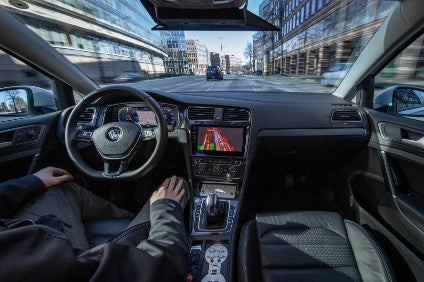
Volkswagen Group Research is testing Level 4 automated vehicles for the first time in urban traffic in Hamburg.
A fleet of five e-Golfs, equipped with laser scanners, cameras, ultrasonic sensors and radars, drive a 3km section of a 'digital test bed' for automated and connected driving in the city. Results will be incorporated into the VW group's numerous research projects for automated driving, and will test customer-centric services and optimise individual transport.
Go deeper with GlobalData


Discover B2B Marketing That Performs
Combine business intelligence and editorial excellence to reach engaged professionals across 36 leading media platforms.
Research chief Axel Heinrich said: "The tests centre on technical possibilities as well as urban infrastructure requirements. In order to make driving even safer and more comfortable in future, vehicles not only have to become autonomous and more intelligent – cities must also provide a digital ecosystem that enables vehicles to communicate with traffic lights and traffic management systems as well as with one another."
A 9km digital test route is currently being constructed in the city with completion scheduled for 2020. The city is upgrading traffic lights with components for infrastructure-to-vehicle (I2V) and vehicle-to-infrastructure (V2I) communication.
Michael Westhagemann, Hamburg's senator for economics, transport and innovation, said: "In 2021, Hamburg will be hosting the World Congress for Intelligent Transport Systems (ITS). Automated driving will play a key role. Volkswagen has already become the first user for our digital test bed. We will establish Hamburg as a model city for intelligent mobility and be presenting numerous innovative mobility projects to a global audience."
The e-Golfs have 11 laser scanners, seven radars and 14 cameras. Up to 5Gb of data are communicated per minute during the regular test drives, each of which lasts several hours. Computing power equivalent to some 15 laptops is tucked away in the boot. This enormous computing capacity, combined with sensor technology, ensures data on pedestrians, cyclists, other cars, intersections, rights of way, parked vehicles and lane changes in moving traffic are captured over the shortest distances and in milliseconds. Despite the diversity and complexity of the information, the artificial intelligence used in the vehicle software must register all relevant objects and respond to them without triggering any false alarms. Several different artificial intelligence approaches are used including deep learning, neural networks and pattern recognition.
Specially trained test drivers are seated behind the steering wheel during all test drives to constantly monitor all driving functions and intervene in an emergency. Various data protection rules – Germany is big on personal privacy as Google Streetview users may have noticed – will be complied with.




