
Volkswagen Rus is calling for a more integrated approach to the supply chain as well as a market-centric push from those in government in Moscow as The Kremlin considers its future strategy for the automotive sector.
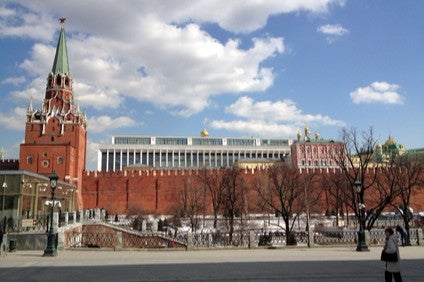
The Russian administration – whose Presidential elections this week (18 March) are widely expected to see Vladimir Putin sweep back through the arches of the Spasskaya Tower on Red Square – has taken a forensic interest in the country’s car sector in the past few years.
Go deeper with GlobalData


Discover B2B Marketing That Performs
Combine business intelligence and editorial excellence to reach engaged professionals across 36 leading media platforms.
That period saw the virtual collapse of the Russian market as a potent cocktail of punitive interest rates, soaring inflation, credit access problems and wide-ranging economic sanctions from an international community outraged at what it perceived as Moscow’s annexation of Crimea and involvement in Eastern Ukraine, combined to depress the market.
But in remarkable contrast – and despite those sanctions remaining firmly in place – Russia has posted almost 12 months of unremittingly positive sales figures – clawing back some of the lost market – albeit from an industry on the floor.
Surfing this tide of improvement however, might see The Kremlin and Duma, Russia’s Parliament, focus more on what specialities the home component market could emphasise.
“What is worrying me a little bit is they [government] want to do everything themselves,” Volkswagen Rus general director, Marcus Osegowitsch, told just-auto on the sidelines of this week’s (14 March) Russian Automotive Forum organised by Adam Smith Conferences in Moscow.
“How does the government make sure what we invested in all the years continues in the future? For us it must be a further and full integration into the global supply chain of car manufacturers. Russia for Russia was the first phase and Russia for the world must be the next phase.
“We have to make sure Russia is very good at a few things like engines [for example]. This isolation discussion, that is the wrong discussion for Russia. We have production over-capacity [and] we have still limited localised supply. Yes, we have Tier 1 suppliers, but unfortunately only mostly for each kind.
“There is also a low rouble localisation which makes us exposed to the high fluctuation of the currency [and] the market will stay volatile. The government wants further localisation, wants to increase exports, wants to do more investment. When is the new investment, new factories, new plants, when is the end? We need to stop – for Russia it is simply too much.”
Urging Moscow to adopt a “simple automotive policy,” the VW Rus chief added companies sometimes made non-profitable decisions just to hit a localisation figure.
Instead of that approach, Osegowitsch stressed the need for a market-centric view of the supply chain, which created more fairness across the board. “Can the government steer this, keeping a fair and even playing field?” he said. “That is why market mechanism is still the best system in the world.
“A gearbox is very hard to justify economically – the global gearbox capacity will be empty in around five years because the world moves to electric. The government needs to seriously think about the economic background further [rather] than saying we want this gearbox production [for example].
“If you want ECUs, please tell Delphi, Bosch, to motivate them, the government needs to take a stake in this. We need to be careful by localising too much.
“It is time to work – in 2020 the current support mechanisms are running out. We are talking to [VW] HQ about 2021/22 – we need quick decisions. Make it simple, make it market-based.
“Somehow, localisation must be economically feasible and please, to the government, attract some of the suppliers because we are producing cars not gearboxes.”




