
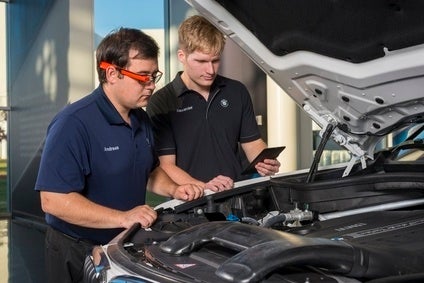
BMW is testing Google Glass eyewear for use in quality assurance in production at its Spartanburg plant in the US.
The pilot project aims at determining whether wearable technology could improve and accelerate the workflows in quality assurance.
Go deeper with GlobalData


Discover B2B Marketing That Performs
Combine business intelligence and editorial excellence to reach engaged professionals across 36 leading media platforms.
Workers use Google Glass to record test series with pre-series vehicles. BMW says the tool allows them to take photos or videos as a means to document potential deviations, providing a better, faster and clearer way to analyse and correct these later on.
Right now, the BMW Group is assessing in which form the pilot application could be transferred to other production areas and sites. The project is an element of the BMW Group’s current “Industry 4.0” campaign, set up to evaluate how new technologies can be applied to provide optimum support to workers in production and production planning.
The purpose of the pilot project at the Spartanburg site is to improve the communication between quality testers at the analysis center of the pre-series production on the one hand and the development engineers on the other.
The smart eyewear makes it possible for the staff at the analysis centre to add photos and video sequences to their reports. The optical head-mounted display is fitted with a camera that has three different settings: photos, video recording, and background video. In the latter mode, the camera is permanently turned on; every two minutes, the video images are stored temporarily and can be later transferred to a BMW Group plant server for permanent storage at the push of a button. This, BMW says, is a “great advantage especially when malfunctions cannot be reproduced clearly”.
“During the term of the pilot project, we are planning to add a video call feature so that a problem can be discussed with the responsible development areas right there and then,” said project coordinator, Dr. Jörg Schulte.
BMW says that so far, the results of the pilot project have been so promising that an application in the final assembly of series vehicles is being considered. In this area, inspections are carried out according to test plans and then documented on stationary computer terminals. Depending on a car’s equipment package, between 10 and 25 individual tests have to be completed. To document them, the testers have to go back and forth between the car and the terminal. “With Google Glass, the testing staff could stay right at the vehicle, look at the test plans on the device’s integrated display and sign them off via voice control. So both hands would be free to conduct the tests at all times,” Schulte says.
The industrial application for Google Glass will be of interest to tech analysts who have recently noted that consumer testing of the eyewear has apparently produced mixed results.




