
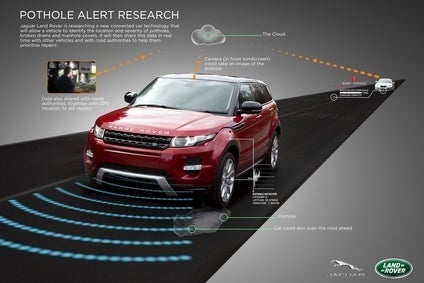
The rise of the sensor and camera-equipped car has enabled Tata Motors’ Jaguar Land Rover to develop an Evoque research vehicle that can identify the location and severity of potholes and broken manhole covers – and adjust suspension settings in milliseconds.
The automaker said it was developing technology to share this data with other cars via the cloud so all drivers get a warning about dangerous potholes and also working with Coventry City Council to understand how sharing data with road authorities could enhance the speed and efficiency of road repairs.
Go deeper with GlobalData


Discover B2B Marketing That Performs
Combine business intelligence and editorial excellence to reach engaged professionals across 36 leading media platforms.
“If a car can receive a warning from another vehicle about severe potholes or broken manholes ahead, then drivers would be able to slow down and avoid the danger – or the car could adjust suspension settings to reduce the impact and smooth the ride. This could help reduce the potential for punctures, wheel and vehicle damage as well as road accidents,” JLR said.
JLR’s global connected car director, Mike Bell, Jaguar Land Rover, said: “Our MagneRide equipped Evoque and Discovery Sport vehicles feature sophisticated sensors that allow the vehicle to profile the road surface under the wheels and identify potholes, raised manholes and broken drain covers. By monitoring the motion of the vehicle and changes in the height of the suspension, the car is able to continuously adjust the vehicle’s suspension characteristics, giving passengers a more comfortable ride over uneven and damaged road surfaces.
“While this gives a more comfortable ride, we think there is a huge opportunity to turn the information from these vehicle sensors into ‘big data’ and share it for the benefit of other road users. This could help prevent billions of pounds of vehicle damage and make road repairs more effective.”
The next stage of the project is to install new road surface sensing technology in the research vehicle, including a forward-facing stereo digital camera.
“At the moment the most accurate data comes from when the car has driven over the pothole or manhole,” said Bell. “So we are also researching how we could improve the measurement and accuracy of pothole detection by scanning the road ahead, so the car could predict how severe they are before the vehicle gets near them.
“Ultimately, sensing the road ahead and assessing hazards is a key building block on our journey to the autonomous car. In the future, we are looking to develop systems that could automatically guide a car around potholes without the car leaving its lane and causing a danger to other drivers. If the pothole hazard was significant enough, safety systems could slow or even stop the car to minimise the impact. This could all help make future autonomous driving a safe and enjoyable reality.”
Road profile information could be shared with road authorities and the automaker is working with Coventry to establish exactly what data would be most useful for roads maintenance teams to identify and prioritise repairs.
Councillor Rachel Lancaster, head of public services at Coventry City Council said: “As part of our ‘smart cities’ strategy, we will be investigating how the pothole alert system could supply us with data in real-time from thousands of connected cars right across our road network. This could give us a very accurate, minute by minute picture of damage to road surfaces, manholes and drains in real time.
“We already collect lots of data which we monitor very carefully ourselves but having this kind of extra information might allow us to further improve our maintenance programmes which would save the taxpayer money.”
The project will also investigate whether the experimental camera could take an image of the pothole or damaged manhole – and share this with the road authorities together with a GPS location.
“We are just beginning to explore how we could use this technology, but data that includes the severity of the issue, its exact location and an image has huge potential,” said Lancaster. “This is just the sort of information that could help us identify the cause of the problem, prioritise it and contact the owner of the manhole or drain to get it fixed more quickly.”




