
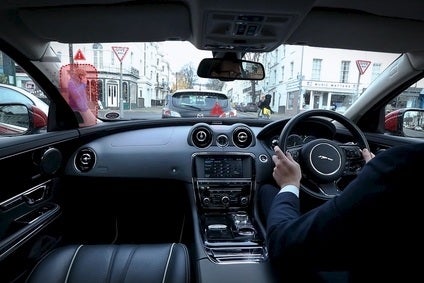
Allowing drivers a 360-degree view around their vehicle is one of the latest projects under research at Tata Motors-owned Jaguar.
JLR engineers are looking at embedding a screen in the surface of each pillar inside the car which would take a live video feed from cameras covering the angles outside the car usually obscured by the A, B- and C-pillars.
Go deeper with GlobalData


Discover B2B Marketing That Performs
Combine business intelligence and editorial excellence to reach engaged professionals across 36 leading media platforms.
Pedestrians, cyclists and other vehicles would be visible all around the car – and by combining the transparent pillars with a head-up display, the movement of other road users could be highlighted to the driver with an on-screen halo moving across the car’s virtual windscreen.
When the driver indicates to change direction, and moves their head to look over their shoulder during an overtake manoeuvre, or as the vehicle approaches a junction, the system would automatically make the left or right-hand side pillars transparent.
Wolfgang Epple, director of research and technology, said: “The JLR research team is developing this technology to improve visibility and to give the driver the right information at the right time. If we can keep the driver’s eyes on the road ahead and present information in a non-distracting way, we can help them make better decisions.”
The ‘360 Virtual Urban Windscreen’ could also be connected to the cloud and to roadside infrastructure and businesses, presenting information ranging from petrol station prices to the number of parking spaces available.
The connected car could also enhance navigation by advising the driver to turn left or right at more visible landmarks, such as pubs or shops, rather than just road signs or street names.
The JLR team is also developing ‘Follow-Me Ghost Car Navigation’ which projects an image of a vehicle in front of the driver’s car for them to follow, turn by turn, to their destination.
Epple added: “Driving on city streets can be a stressful experience but imagine being able to drive across town without having to look at road signs, or be distracted trying to locate a parking space as you drive by. We want to present all of this information on a heads-up display in the driver’s eye-line, so the driver doesn’t have to seek it out for themselves and take their eyes off the road ahead.”




