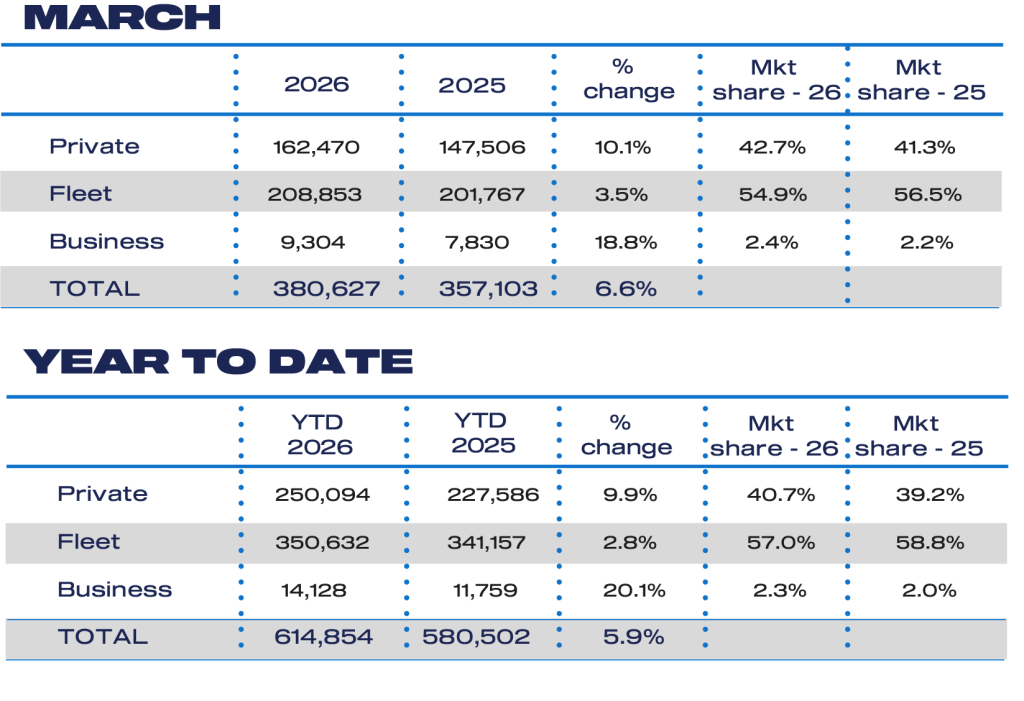
The UK new car market grew by 6.6% in March, typically the busiest month of the year, with 380,627 new vehicles registered, according to the latest figures published by the Society of Motor Manufacturers and Traders (SMMT). The performance marks the best March – and best month overall – since 2019.
Go deeper with GlobalData


Discover B2B Marketing That Performs
Combine business intelligence and editorial excellence to reach engaged professionals across 36 leading media platforms.
Growth was driven primarily by private demand, with retail registrations rising 10.1% to 162,470 units. Fleet registrations increased 3.5% to 208,853 units, while the smaller business sector grew 18.8% to 9,304 units.
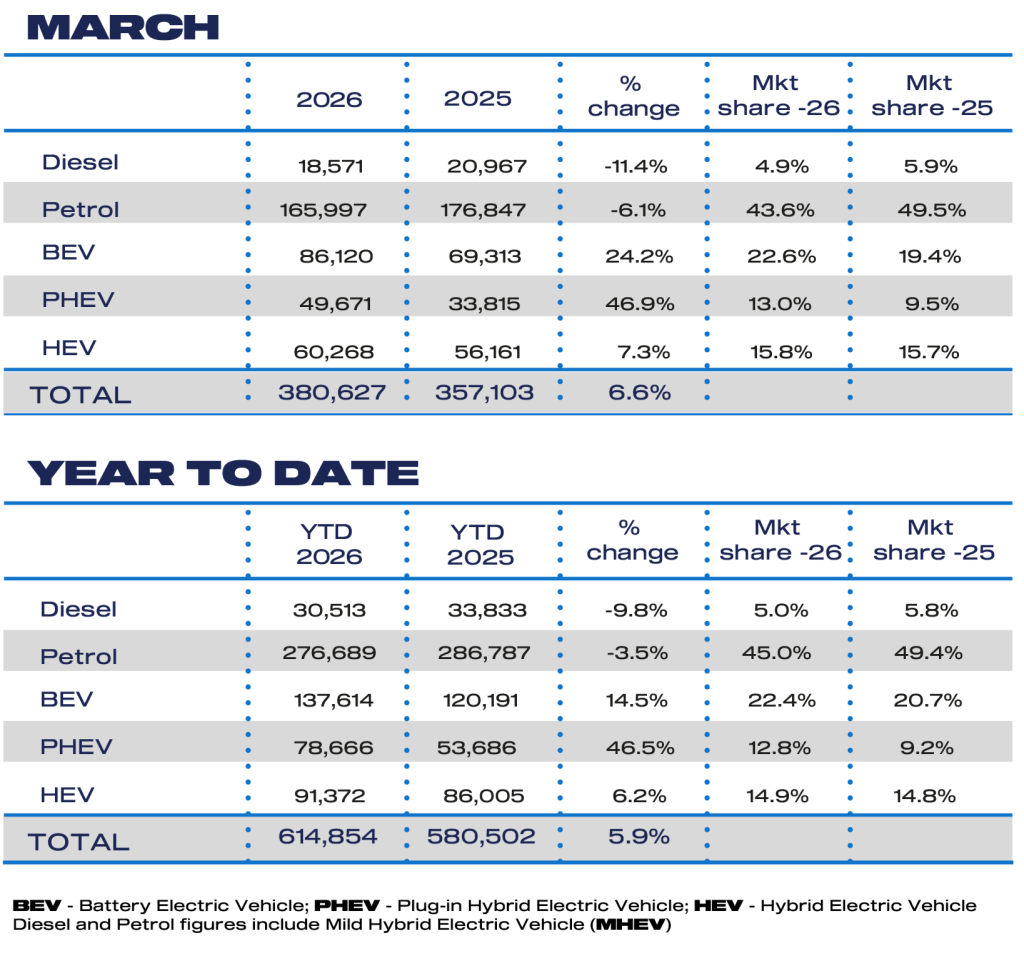
March was also the best month on record for electrified vehicle volumes, accounting for 196,059 registrations, underlining the impact of manufacturers’ investment in road transport decarbonisation. Plug-in hybrid (PHEV) registrations rose 46.9% to take a 13.0% market share, while hybrid electric vehicles (HEVs) increased 7.3% to take 15.8% of the market. Battery electric vehicles (BEVs) reached a new record, up 24.2%, to 86,120 registrations in the month. However, with a market share of only 22.6% for the month, and 22.4% year to date, the SMMT notes that uptake is now even further adrift of the Zero Emission Vehicle (ZEV) Mandate target, which demands 33% for 2026.
Despite rising EV volumes, conditions have diverged sharply from those assumed when the mandate was set. At the start of 2026, battery costs were more than 30% higher than expected and industrial energy prices around 80% above 2021 levels, while public charging can cost over 140% more than five years ago. Future costs and, therefore, demand are even more uncertain given the Iran crisis, which may spark interest in EVs but risks pushing up energy and supply chain costs, increasing the cost of living and undermining consumer confidence.
While government has acknowledged these pressures – and sought to support the market, most notably through the introduction of the Electric Car Grant – manufacturers are still forced to shoulder unsustainable costs to comply with the regulation when natural demand lags ambition. Alongside billions invested in both the technology and product to deliver a choice of more than 160 EV models, manufacturers are relying heavily on discounting to stimulate demand.
Industry’s calls for a rapid review of the transition have been given added urgency by geopolitical events. While other major international markets are revising their transition plans to reflect geopolitical and market realities, delays to a review of the UK transition will put the country in an uncompetitive position, undermining consumer choice, investment and, ultimately, the pace of decarbonisation.
Mike Hawes, SMMT Chief Executive, said: “The strongest new car market since 2019, with the highest ever volume of EV registrations, is a boost to the industry and the economy. However, the headlines belie the costs incurred and the challenges involved. Much of March’s performance will be from orders placed before the start of the Iran conflict, which threatens to raise the cost of living, undermining consumer confidence. Against this backdrop, and with the EV market falling further away from mandated levels despite record levels of incentives, an urgent review of the transition is required to secure a sustainable market, economic growth and the UK’s net zero ambitions.”
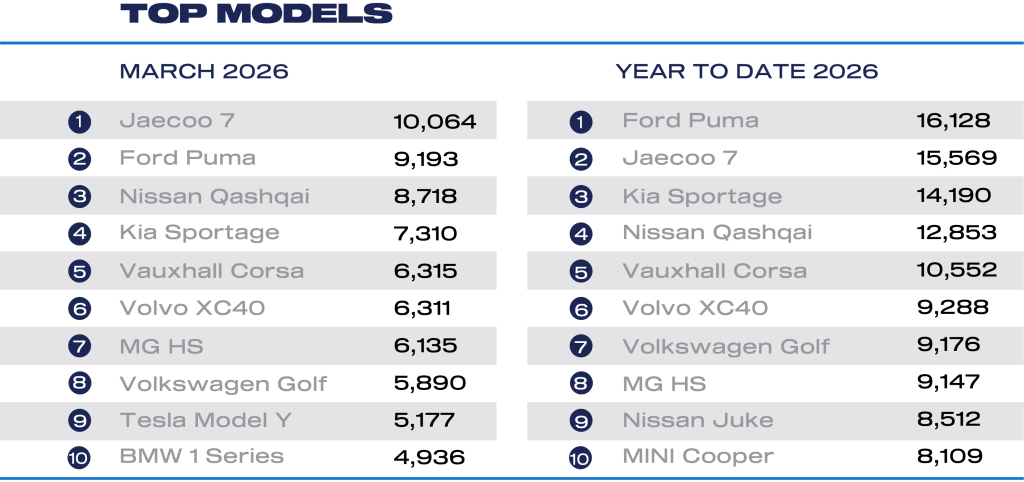
The Jaecoo 7 – from Chery’s Jaecoo brand – was the top selling model in the UK new car market in March, outselling the Ford Puma in second spot.