
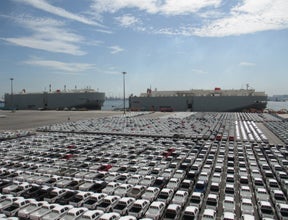
The value of vehicles exported from South Korea rose by 2% to US$72.0 billion in 2025, up from US$70.8 billion in 2024, driven by strong overseas demand for hybrid vehicles, according to data released by the country’s Ministry of Trade, Industry and Energy. Last year was the third consecutive year that the country’s vehicle exports exceeded US$70 billion.
Exports of eco-friendly vehicles, including hybrid and electric vehicles, rose by 11% to US$ 25.8 billion, driven by a 30% increase in hybrid vehicle shipments to US$ 14.8 billion. Exports of used cars surged by 75% to a record high of US$ 8.9 billion, which the ministry said reflected the improved reputation of South Korean vehicles in overseas markets and favourable exchange rates.
Go deeper with GlobalData


Discover B2B Marketing That Performs
Combine business intelligence and editorial excellence to reach engaged professionals across 36 leading media platforms.
In terms of volumes, new vehicle exports fell by 1.7% to 2.7 million units last year, accounting for 67% of vehicle production in the country. Domestic vehicle production fell by 0.6% to 4.1 million units, with the GM Trax the highest-volume model with output of 308,000 units, followed by the Hyundai Kona with 270,000 units, Hyundai Avante with 269,000 units, Kia Sportage with 226,000 units, Hyundai Tucson with 201,000 units, and the Kia Carnival with 186,000 units.
The Ministry said in a statement: “Although US tariff measures cast a shadow over the automobile industry in 2025, uncertainty was eased through a combination of policy measures, including efforts to strengthen competitiveness in eco-friendly vehicles and secondary batteries, and emergency responses to the tariffs, together with the successful conclusion of tariff negotiations with the US.”
The Ministry said that in 2026 the country’s automobile industry faces challenges such as increased localisation of production overseas due to rising global protectionism and intensifying competition. It stated that it will continue to support the industry by “steadily implementing initiatives centered on the AI Future Vehicle M.AX Alliance and the K-Mobility Leadership Strategy, with the aim of strengthening future industrial competitiveness and reinforcing export momentum.”
GlobalData expects light vehicle production in South Korea to fall by 6% to 3.809 million units in 2026, down from 4.051 million units in 2025.




