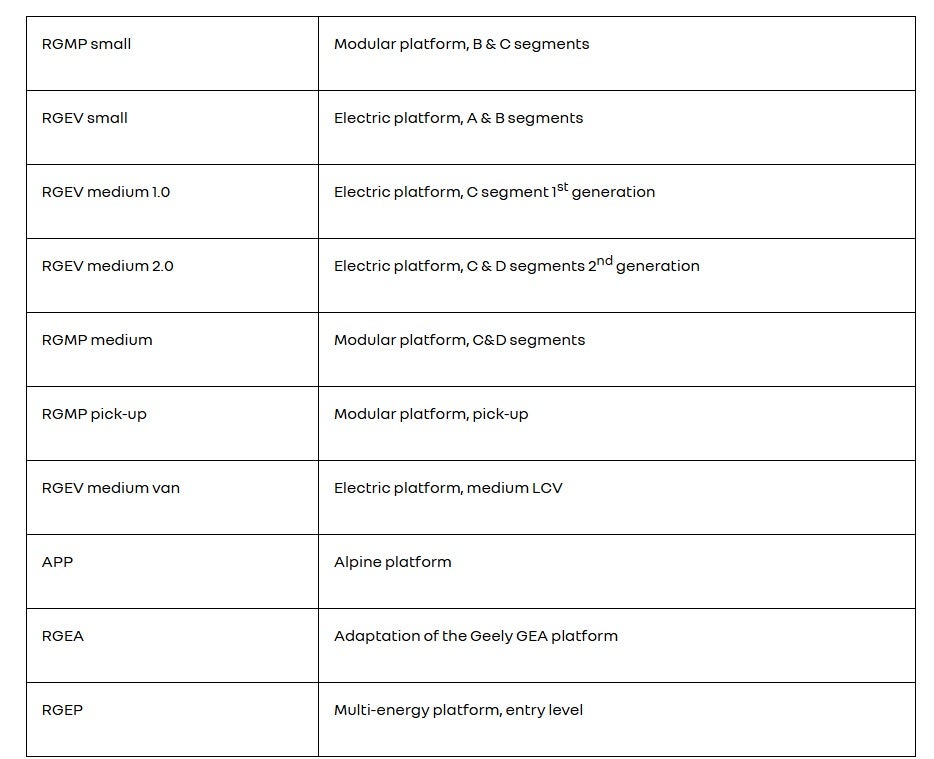
Renault says its first strategic priority is the next generations of C-segment electric vehicles, which will be supported by its new RGEV medium 2.0 electric platform.
Go deeper with GlobalData


Discover B2B Marketing That Performs
Combine business intelligence and editorial excellence to reach engaged professionals across 36 leading media platforms.
Featuring an 800 volts electric architecture, Renault maintains the new platform will deliver an ultra-fast charging in as a little as 10-minutes by 2030. Renault is planning for the new modular platform to accommodate a wide range of models from the B+ to D segments. It will also have the versatility to accommodate all body styles: saloon, SUV and MPV.
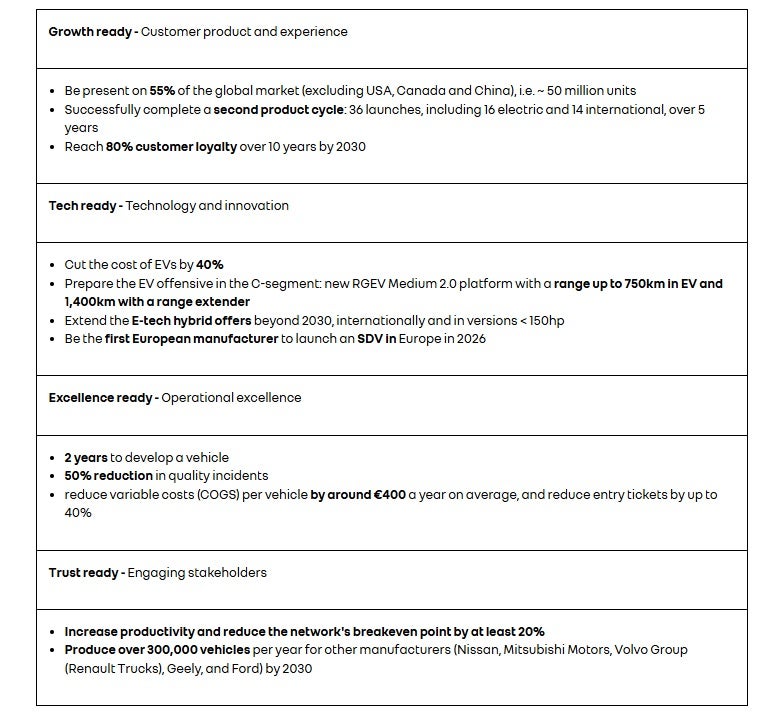
In terms of energy integration, the battery will have a maximum fill rate of 70%, with a cell-to-body design, 20% fewer parts and compatibility with pouch, prismatic and blade cells. The company claims the range will be on a par with the best: up to 750 km WLTP for an EV version and up to 1,400 km with an EV Range Extender, with emissions of under 25g of CO₂/km.
With the centralised Software Defined Vehicle (SDV)[2] architecture, 90% of functions will be updated by FOTA (Firmware Over The Air), halving the time required for implementation. It will also be the first carOS co-developed with partner Google, based on Android. The next step will be for the SDV to evolve towards the Artificial Intelligence Defined Vehicle (AIDV), able to control infotainment, ADAS and the chassis, paving the way for the intelligent car, the company says.
This new platform will be developed primarily in France and cut costs by 40% compared with the current generation of electric vehicles, Renault claims.
Renault has outlined the electric vehicle plan as part of its new strategic plan – futuREady.
The company says product remains front and centre of this strategy. Renault Group will launch 36 new models between now and 2030, accelerating electrification and also its international line-up, it says.
Over the medium term, Renault Group aims to generate consistently robust and resilient financial results, with a group operating margin of between 5% and 7% of revenue and an Automotive free cash flow superior or equal to €1.5 billion per year on average.
Renault’s new strategy at a glance:
Batteries for two customer sets
For electric powertrains, Renault says batteries will implement two types of chemistry, meeting different customer requirements:
- “High energy density” chemistry for high-power and/or very long-range models. Vehicles using this type of chemistry will gradually switch to the 800 volts architecture from 2028, to reach a fast-charging time of up to 10 minutes, depending on the planned capacity of the European network in 2030.
- “Affordable” chemistry, for small cars and standard-range versions. Vehicles in segments A-B will remain in 400 volts, with a charging time of 20 minutes in 2030. Note that the RGEV medium 2.0 platform can also deliver a longer range with this type of “affordable” chemistry, without sacrificing charging time, thanks to its native 800 volts architecture and 10-minute charge.
The key component in the electric drivetrain is the electric motor. Renault plans to develop a third-generation rare-wound rotor motor using no rare earths. With claimed efficiency of 93% on the motorway and 25% more power, this 275 hp motor will be developed and built in-house, and available in both front and rear-wheel drive versions. Coupled with innovative, scalable “7-in-1” power electronics, this motor will cost 20% less than the previous generation.
All technologies will be developed in Europe for European markets, the company says.
For hybrids (HEV), Renault Group will continue to extend its E-Tech technology beyond 2030 with new versions under 150 hp. It will also deploy this technology outside Europe, with a significant reduction in cost, it is claimed.
Renault’s platforms: