
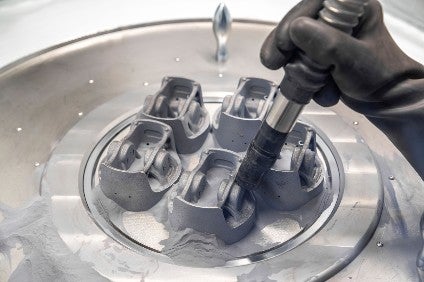
Porsche, with Mahle and Trumpf, is now making pistons for the 911 flagship model, the GT2 RS, using a 3D printer.
The automaker and suppliers said 3D printing allows the pistons to be manufactured with a structure that is optimised for the loads acting on them.
Go deeper with GlobalData


Discover B2B Marketing That Performs
Combine business intelligence and editorial excellence to reach engaged professionals across 36 leading media platforms.
Pistons from this advance development project weigh 10% less than the forged series production pistons.
They also have an integrated and closed cooling duct in the piston crown that could not have been produced by conventional methods.
“Thanks to the new, lighter pistons, we can increase the engine speed, lower the temperature load on the pistons and optimise combustion,” said Frank Ickinger, advance drive development department, Porsche.
“This makes it possible to get up to 30PS more power from the 700PS biturbo engine while at the same time improving efficiency.”
There are a number of different technologies for 3D printing.
All are based on the principle that components are built up layer by layer without the need to previously manufacture a special tool or mould.
Practically any geometric shape can therefore be achieved while the printer can be sent design data directly digitally.
Additive manufacturing processes are thus ideal for producing structures that have been designed and optimised by means of artificial intelligence (AI), according to Porsche.
The GTS R2 pistons were manufactured from high purity metal powder using the laser metal fusion process (LMF) where a laser beam heats and melts the powder surface corresponding to the part contour.
The quality and performance capability of the components developed with Mahle and Trumpf were validated using measurement technology from Zeiss.
Porsche already uses additive manufacturing processes in several areas. For example, a 3D-printed bodyform full bucket seat has been used since May for the 911 and 718 model lines.
The central section of the seat – cushion and backrest surfaces – is produced partly by 3D printer.
Customers will, in future, be able to choose between three firmness levels for that comfort layer.
Porsche Classic also uses additive processes to reproduce plastic, steel and alloy spare parts that were previously no longer available.




