
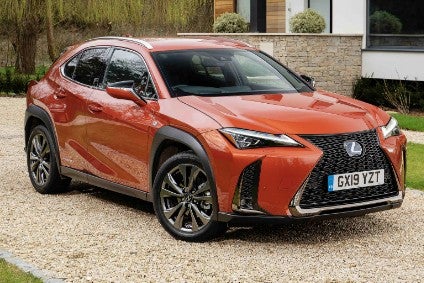
Toyota's Lexus Europe first half 2019 sales rose 5% year on year to 40,450 units as 'self-charging' hybrids accounted for 95% of volume in western and central Europe, boosted by the newly launched UX compact SUV and ES premium saloon.
Lexus' said the premium market declined slightly overall (-2%) but "significant" growth was recorded in the UK (8%), Italy (51%), Germany (33%), Spain (19%), Poland (13%) and France (12%).
Go deeper with GlobalData


Discover B2B Marketing That Performs
Combine business intelligence and editorial excellence to reach engaged professionals across 36 leading media platforms.
Growth was driven mainly by the two completely new models, the UX and ES. After five months on sale, the UX made 8,532 sales of the brand's debut model in the fast growing premium compact SUV segment.
ES achieved the largest growth with sales up by 387% to 3,012 units following the introduction of the new generation model and the extension of sales across the whole of Europe (including the UK) at the end of 2018.
Previously, like the recently re-launched Toyota Camry, it was sold only in Russia and selected eastern European markets.
Self-charging hybrids – as Toyota units now bill non-plug-in hybrids, now account for 95% of Lexus sales in western and central Europe. This is despite having lost some 'electric car' perks such as free entry to London's congestion charge zone.
The NX mid-size SUV remained the best selling Lexus in Europe, with 11,699 copies retailed, while the larger RX tally was 8,382.
Lexus Europe territory is the European Union countries, Norway, Iceland and Switzerland, Russia, Ukraine, Kazakhstan, the Caucasus region, Turkey and Israel.




