
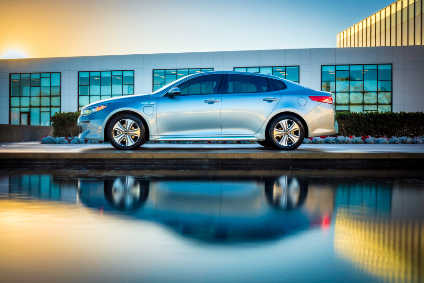
The European launch of the Optima Plug-in hybrid is an an important part of Kia’s mission to lower the average CO2 of its range by 25% before the end of the decade. With a range of up to 33 miles in all-electric mode, the car can complete many regular urban commutes with no tailpipe emissions.
A CO2 figure of just 37g/km also brings company vehicle users in some countries benefits in kind when it comes to taxation as well as qualifying for government incentive grants. The Optima PHEV, Kia’s first plug-in hybrid marries a 154hp 2-litre injection petrol engine with a 50kW (67hp) electric motor powered by a 9.8kWh lithium-ion polymer battery pack.
Go deeper with GlobalData


Discover B2B Marketing That Performs
Combine business intelligence and editorial excellence to reach engaged professionals across 36 leading media platforms.
The electric motor replaces the torque converter in the six-speed automatic transmission. Working together the combustion engine and motor generate 202hp and 375Nm of torque. The powertrain has been three years in development said hybrid engineer Neumg Seop Oh, who is based at the Hyundai-Kia technical centre in Namyang, South Korea.
Hybrid sales in Europe have doubled over the past five years and are expected to reach 700,000 by the end of the decade. With the US also an important market, Oh said that he and his team benchmarked rivals such as the Toyota Camry and Volkswagen Passat.
Initially available in the Optima Sedan, Oh said the PHEV powertrain will be available next year in the new Optima Sportwagon, also currently being launched in Europe. He added: “Our focus during development was not only on fuel economy but in drive-ability and we believe we have achieved best in class in both areas. The PHEV is capable of achieving a range of up to 980kms.”
Kia’s regenerative braking system, now in its third generation, allows the car to harvest kinetic energy to top up the batteries when coasting or braking. To compensate for the additional weight of the battery pack, the all-independent suspension has been specially tuned while brakes have been enlarged compared to those on the diesel-engine model.
Kia’s presence in the D-segment is also expanded with the Sportwagon – in Europe, two thirds of sales in this segment and 75% of fleet sales are taken by wagons/estates. The Sportwagon was designed in Europe and will only be sold there. The new model remains close to the Sportspace concept revealed at last year’s Geneva Motor Show and features a minimum of 552 litres of cargo space, including two underfloor trays, and 1,686 litres with the rear seats folded.
It is sold exclusively with Kia’s 1.7-litre turbo-diesel and is available with a full suite of advanced connectivity and active driver assistance technologies including Android Auto, Apple CarPlay – available later in the production run – Kia connected services powered by TomTom and an eight-speaker Harman audio system.




