
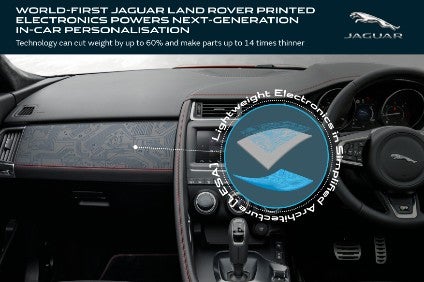
Tata Motors' Jaguar Land Rover thinks its "pioneering structural electronics research" could see dashboards replaced by curved screens and allow drivers to customise interiors thanks to colour changing body panels.
In a claimed world first, the British automaker is developing Lightweight Electronics in Simplified Architecture (LESA) research technology – used in flexible wearables and curved OLED TVs – for car interiors.
Go deeper with GlobalData


Discover B2B Marketing That Performs
Combine business intelligence and editorial excellence to reach engaged professionals across 36 leading media platforms.
This, JLR said, has the potential to radically change cabins of the future and would offer customers greater ability to customise their cars to suit their needs.
Using LESA technology, the automaker and its suppliers would will be able to manufacture body panel displays to show information only when needed to help designers achieve streamlined and buttonless designs for future cars. Such designs may include customisable interior ambient lighting systems, body controls, wrap around, no button dashboards and advanced fabric/leather heated steering wheels.
The innovative printed electronics system would also reduce the weight of car electronics by up to 60% as wiring, sensors and computing are contained within all non-metal materials, removing the need for extra packaging space for control units.
Features using LESA technology would be created using a faster, simpler and more automated process, be more flexible in usage and offer technological advancements – such as making digital displays appear on surfaces like wood without the need for a screen. It also makes adding solar panels to the vehicle possible without adding extra system weight to the car. Solar power could then be used to recharge the battery.
The system uses computer animated drawings (CAD) to virtually 'unfold' a part into its 2D structure. The required electronic circuit, ordinarily wired into a traditional ECU, is then printed onto the flat surface, and components are mounted, before the CAD is folded back into its original 3D. The part is then manufactured with the electronics printed into the structure.
JLR said it had successfully trialled LESA technology on a prototype overhead control panel, achieving weight reduction of 60% and reducing the part size from 50mm to just 3.5mm.
The research received an Institution of Engineering and Technology (IET) Innovation award with judges praising it as "the future of electronics in the car".
Ashutosh Tomar, the automaker's electrical research technical manager, said: "Healthcare, aerospace, consumer technology and military industries are already harnessing the benefits of structural electronics and our research is leading the way in the automotive sector by bringing it into the cabin for the first time.
"We believe LESA represents the future of vehicle electronics and will enable us to design and manufacture innovative, flexible and customisable cabins for our customers while also reducing weight and cost during production."




