
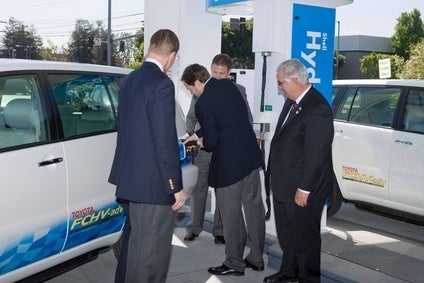
Toyota will help local authorities in Japan and the US create infrastructure for refuelling hydrogen-powered cars to help speed up the spread of fuel cell vehicles.
Next year in Japan, Toyota will introduce a number of trailer stations that can be moved to different locations at a cost of around JPY200m (US$1.94m), an upfront investment less than half that of a stationary fuelling station. Full fueling will take about three minutes.
Go deeper with GlobalData


Discover B2B Marketing That Performs
Combine business intelligence and editorial excellence to reach engaged professionals across 36 leading media platforms.
Last week it was reported that Toyota “is walking away” from building longer range battery electric vehicles in favour of hydrogen fuel cell vehicles.
Jim Lentz, CEO of Toyota’s North American region, said Toyota sees battery-electric vehicles as viable only in a select way, in short-range vehicles and, because hydrogen fuel cells are cheaper on a cost per vehicle basis and are more efficient on a well to wheel basis, Toyota has turned away from a 20-year effort to create a viable battery-electric vehicle.
A Toyota study has calculated that it will take 68 refueling stations to meet the needs of 10,000 California fuel cell customers so they don’t worry about being stranded. By the end of 2016, California should have 50 stations in operation.
This marks the first attempt by an carmaker to build a hydrogen supply infrastructure. Toyota plans to release fuel cell vehicles for general markets next year with production estimated to reach 1,000.
It is hoped that, in future, a refuelling network will be established through cooperation between carmakers, major gas and oil providers and governments. Currently, Japan has only about 20 hydrogen stations in Tokyo, Aichi Prefecture and elsewhere, and most are service station type facilities.
In in the US, Toyota will invest in startup FirstElement Fuel which operates hydrogen stations in California. The venture, supported by state subsidies, aims to build more than 19 hydrogen stations within the state.
In Germany, Daimler is working with the government and related industries to set up roughly 400 hydrogen stations by 2023.




