
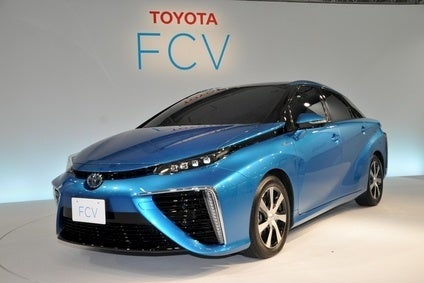
Toyota has revealed the exterior design and Japan pricing of its hydrogen fuel cell sedan, first unveiled as a concept at the Tokyo motor show last year.
The car will launch in Japan “before April 2015” with US and European launches scheduled for next summer.
Go deeper with GlobalData


Discover B2B Marketing That Performs
Combine business intelligence and editorial excellence to reach engaged professionals across 36 leading media platforms.
In Japan, the fuel cell sedan will be sold through the Toyota and Toyopet dealer networks, priced around JPY7m/US$68,660 (excluding consumption tax).
Sales initially will be limited to regions where hydrogen refueling infrastructure is being developed.
In Japan, these are metropolitan Tokyo plus Saitama, Chiba, Kanagawa, Yamanashi, Aichi, Osaka, Hyogo, Yamaguchi and Fukuoka prefectures.
US and European prices have not yet been decided, Toyota said in a statement, adding that detailed specifications, exact prices and sales targets will be announced later.
“Hydrogen is a particularly promising alternative fuel since it can be produced using a wide variety of primary energy sources, including solar and wind power,” the automaker said. “When compressed, it has a higher energy density than batteries and is easier to store and transport. In addition to its potential as a fuel for home and automotive use, hydrogen could be used in a wide range of applications, including large scale power generation.”
Toyota has been developing fuel cell vehicles in-house for over 20 years and, some years ago, demonstrated the technology here in Europe in a prototype based on the US market Highlander [Kluger] SUV.
Its latest fuel cell system includes a proprietary FC Stack, which generates electricity from the chemical reaction between hydrogen and oxygen, and high-pressure hydrogen tanks.
Earlier, in 2002, Toyota had begun leasing a small number of the Highlander-based FCHV fuel cell SUVs in Japan and the US.
Significant improvements have been made to the FC system since 2002, the automaker said on Wednesday. The revealed today has performance similar to a petrol engine vehicle with a cruising range of approximately 700km/430 miles (according to measurements taken under the Japanese Ministry of Land, Infrastructure, Transport and Tourism’s JC08 test cycle) and a refueling time of roughly three minutes. When driven, it emits only the water vapour produced by the reaction between hydrogen and oxygen.
“Fuel cell vehicles contribute to the diversification of automobile fuels, emit no CO2 or environmentally harmful substances during operation, and offer the convenience of gasoline-powered cars. Toyota believes they have a great deal of potential, and are ideal environment-friendly vehicles for promoting a sustainable mobility society,” the automaker said.
Toyota Group companies are also engaging in other hydrogen-related initiatives, such as developing and testing fuel cells for use in homes, and developing fuel cell forklifts and fuel cell buses.




