
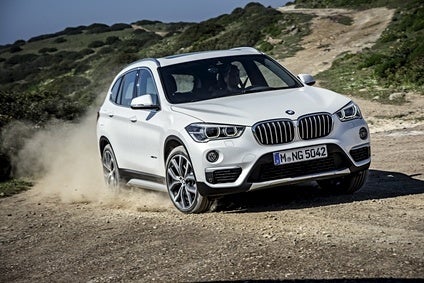
BMW has now confirmed full details of its second generation X1 crossover which now has the group’s front- and all-wheel drive Untere Fahrzeugklasse (UKL1) architecture as its basis.
According to just-auto‘s Production Lifecycle Database (PLDB) there should eventually also be an additional variant, the X2, in the same way that the X5 and X6, as well as the X3 and X4, are related. This will be a sportier crossover and challenger for the Audi Q2.
Go deeper with GlobalData


Discover B2B Marketing That Performs
Combine business intelligence and editorial excellence to reach engaged professionals across 36 leading media platforms.
Unlike the first generation, no iI6 engines will be offered. A long-wheelbase version for China is also likely.
At launch, one petrol engine and three diesels will be offered.
Standard specification includes LED daytime driving lights and for xLine and M Sport models full-LED headlights for low and high beam. This is optional for Sport line models.
The new car has grown in height compared to its predecessor (+53mm), which helps to create extra space in the interior.
Navigation is standard as it is on all UK market BMWs from September 2015.
The X1 has new powertrain and chassis technology with front, transverse-mounted I4 engines and a newly developed xDrive intelligent all wheel drive system or front wheel drive.
All four launch engines are two-litre units with TwinPower Turbo technology.
A new xDrive25d version has multi-stage turbocharging with variable turbine geometry in both the high-pressure and low-pressure chargers. With a maximum output of 231hp, the new engine is the most powerful I4 diesel ever used in a BMW and its peak torque of 450Nm is available between 1,500 and 3,000rpm. Eight-speed Steptronic transmission is standard.
Entry level models have a six speed manual gearbox as standard.
Chassis technology now includes single-joint strut suspension at the front and a multi-link rear axle. Aluminium swivel bearings, as well as axle carriers and control arms made from high-strength steel, reduce weight and increase the rigidity of the front axle. The rear axle also employs a high proportion of high-strength steels. Tube-shaped anti-roll bars at the front and rear axle, innovative axle mounting and specially tuned elastokinematics contribute to agility and ride comfort, as do the connection of the dampers to the body via sophisticated three-way support mounts.
Servotronic speed-sensitive steering assistance is standard with Variable Sports Steering new to the options list. This allows parking and turning-off manoeuvres to be completed safely and comfortably with little steering effort, with very precise steering at higher speeds, the automaker said. M Sport suspension is also available as an option, with firmer spring and damper settings and a 10mm lower ride height. Dynamic Damper Control also comes to the X1 for the first time.
Aerodynamics imporvements include air flaps in the grille and the front apron’s lower intake can be actively shut off when the cooling requirement is low, reducing drag at the front of the car. Air curtains integrated into the outer air intakes channel the onrushing air behind the front side panels, causing it to hang over the wheels like a curtain and thus reduce turbulence.
The X1 goes on sale across Europe later this year with UK sales starting on 24 October.
According to PLDB, build will be in Germany (Regensburg, starting August), China (Shenyang) and Brazil (Araquari). The car makes its public debut at September’s Frankfurt IAA.
Average annual lifecycle production volumes
Regensburg 105,000
Araquari, Santa Catarina 2,000
Brilliance BMW: Tiexi, Shenyang, Liaoning 50,000




