
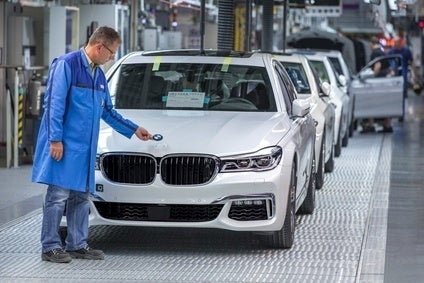
BMW will build its redesigned 7 Series in Dingolfing, main factory source for the predecessor models.
Series production of the sixth generation starts on 1 July.
Go deeper with GlobalData


Discover B2B Marketing That Performs
Combine business intelligence and editorial excellence to reach engaged professionals across 36 leading media platforms.
The model dates back decades but 370,000 of the fifth generation, made from 2008 were built in Dingolfing and shipped to around 100 countries. Since the launch of the first generation in 1977, Dingolfing has built about 1.6m. Main markets are China, the US, Germany, the Middle East, Russia, Korea, the UK and Japan. Taking into account all the diverse engine, colour and customer-specific options, countless vehicle variants (1,070 options) can be produced. Barely any two cars leaving the Dingolfing line are the same.
SKD/CKD assembly is expected at the same plants which made or still make the F01-F04 series 7 Series sedan – Thailand, India and Egypt, according to just-auto’s PLDB.
BMW management board chairman Dingolfing Krüger said: “We have invested more than half a billion euros in the plant in the past three years alone for this purpose. The plant has been developed and adapted so that it is fully prepared for the future with new technologies, such as carbon fibre and electrification. This represents a clear commitment on the part of the BMW Group to both Dingolfing as a high-tech production location, and to Germany.”
Weight reduction was a key goal of the 7 Series development: carbon fibre reinforced plastic (CFRP) is used in the passenger compartment because it is around 30% lighter than aluminium and about 50% lighter than steel. The unique body structure, referred to as the ‘carbon core’, is based on technology transferred from the Leipzig-built i models and the new generation models weigh up to 130kg less than the previous generation.
This is the first core model BMW to use industrially manufactured carbon fibre in combination with steel and aluminium in the body structure rather than as a visible shell material. Carbon fibre is used for the roof bows, to reinforce the roof frame, the B and C pillars, the sills, the centre tunnel and for the rear shelf. Wet pressing and hybrid pressing are new to Dingolfing.
In wet pressing, carbon-fibre fabrics or netting, impregnated with resin, are pressed in a three-dimensional moulding die while wet and then hardened. The dry pre-shaping previously used in the resin transfer moulding (RTM) process is no longer required. In hybrid pressing, carbon-fibre fabrics impregnated with resin, also still wet, are placed in a moulding die with sheet steel, then pressed and hardened. This bonds the steel and carbon materials to form a hybrid component. Hybrid components are light, but offer maximum rigidity and outstanding crash performance. Both processes enable highly economical large-scale production of up to several thousand carbon components per day, with compact systems engineering and short cycle times.
Dingolfing plant head Josef Kerscher said: “The structures and new manufacturing technologies for lightweight construction and electrification we established for the BMW 7 Series ramp-up will also benefit other models built at Dingolfing.”




