
Audi says it has taken another step in the direction of CO2 neutral fuel with the development of a new ‘synthetic’ diesel oil for future use in automobiles.
A pilot plant in Dresden has started production of the synthetic fuel ‘Audi e diesel’.
Go deeper with GlobalData


Discover B2B Marketing That Performs
Combine business intelligence and editorial excellence to reach engaged professionals across 36 leading media platforms.
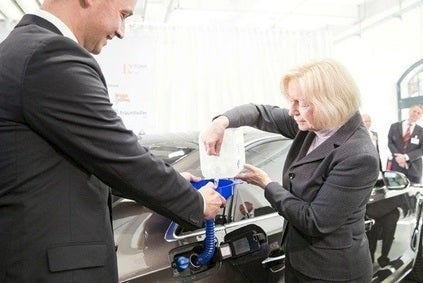
After a commissioning phase of just four months, the research facility in Dresden started producing its first batches of ‘high quality’ diesel fuel earlier this month. To demonstrate its suitability for everyday use, German Federal Minister of Education and Research Prof. Dr. Johanna Wanka put the first five litres into her official car, an Audi A8 3.0 TDI clean diesel quattro.
“This synthetic diesel, made using CO2, is a huge success for our sustainability research. If we can make widespread use of CO2 as a raw material, we will make a crucial contribution to climate protection and the efficient use of resources, and put the fundamentals of the ‘green economy’ in place,” said Wanka.
The Dresden energy technology corporation sunfire is Audi’s project partner and the plant operator. It operates according to the power to liquid (PtL) principle and uses green power to produce a liquid fuel. The only raw materials needed are water and carbon dioxide. The CO2 used is currently supplied by a biogas facility. In addition, initially a portion of the CO2 needed is extracted from the ambient air by means of direct air capturing, a technology of Audi’s Zurich based partner Climeworks.
Reiner Mangold, Head of Sustainable Product Development at Audi, sees Audi e diesel and Audi e fuels in general as an important component that complements electric mobility: “In developing Audi e-diesel we are promoting another fuel based on CO2 that will allow long distance mobility with virtually no impact on the climate. Using CO2 as a raw material represents an opportunity not just for the automotive industry in Germany, but also to transfer the principle to other sectors and countries.”
Production of Audi e diesel involves various steps: First, water heated up to form steam is broken down into hydrogen and oxygen by means of high-temperature electrolysis. This process, involving a temperature in excess of 800 degrees Celsius, is more efficient than conventional techniques because of heat recovery, for example. Another special feature of high-temperature electrolysis is that it can be used dynamically, to stabilize the grid when production of green power peaks.
In two further steps, the hydrogen reacts with the CO2 in synthesis reactors, again under pressure and at high temperature. The reaction product is a liquid made from long chain hydrocarbon compounds, known as blue crude. The efficiency of the overall process – from renewable power to liquid hydrocarbon – is very high at around 70 percent. Similarly to a fossil crude oil, blue crude can be refined to yield the end product Audi e diesel. This synthetic fuel is free from sulfur and aromatic hydrocarbons, and its high cetane number means it is readily ignitable. As lab tests conducted at Audi have shown, it is suitable for admixing with fossil diesel or, prospectively, for use as a fuel in its own right.
The German Federal Ministry of Education and Research is supporting the sunfire project, which started in May 2012. Construction work on the facility in Dresden Reick kicked off in July 2013 and the plant was commissioned on November 14, 2014. The plant is set to produce over 3,000 litres (792.5 US gal) of Audi e diesel over the coming months. Audi is sunfire’s exclusive partner in the automotive sector.




