
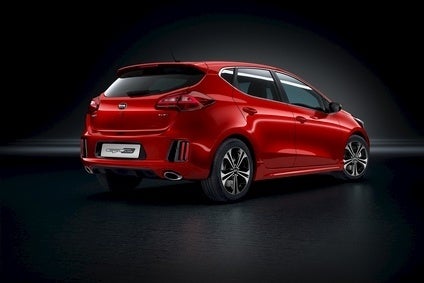
Kia is planning to reinforce its position as the sporty division of the Hyundai Motor Group in Europe with a new range of GT Line models with their own styling additions, powetrains and suspension settings.
The GT Line treatment is being applied first to all three body styles of the European cee’d range. The GT Line cars will sit between the mainstream models and the most sporty GT versions.
Go deeper with GlobalData


Discover B2B Marketing That Performs
Combine business intelligence and editorial excellence to reach engaged professionals across 36 leading media platforms.
They will be powered by the one-litre, three-cylinder direct-injection Kappa turbo engine revealed at the Paris show last autumn, or a new 131bhp development of Kia’s European-made 1.6-litre U2 turbodiesel, which will be the first car to offer the seven-speed double-clutch automatic transmission also unveiled at Paris.
Artur Martins, the marketing vice-president for Kia Motors Europe, said at the Geneva show: “This is the way we as a brand want to go. We want to give the same look and feel as the GT to customers who are not looking for a very powerful car.”
The idea was driven by customers who like some of the details of the GT models – not least its diamond-like front foglights – but who want to avoid the higher running costs that go with a hot hatch, said Martins.
“We think this will attract a lot of customers. The GT Line could take 15-20% of sales. We are investigating how it would work for other models, but we think it should fit with all our products. We are also finalising the decision on whether to offer an improved version of the suspension and steering.”
There will also be more be more full GT models and more Kappa petrol engines – three- and four-cylinder – to fit in with Hyundai-Kia’s downsizing strategy.
More models will also get the one-litre engine but Kia will not spread it around as liberally as other marques have with similar power units, said Michael Winkler, the head of the group’s powertrain division in Europe.
“It is a matter of what is the proper engine size for which segment. The engine size has to fit the vehicle size,” he said.
The Kappa turbo is unusual for a three-cylinder in that it requires no balancer shaft to counter noise, vibration and harshness, which saves cost and weight, said Winkler. It is based on the normally aspirated port-injection one-litre Kappa unit but has required extensive re-engineering for direct injection and turbocharging, especially as it will be covered by Kia’s seven year, 100,000 mile warranty.
“We had to make sure that claims would not be a problem,” said Winkler.




