
Renault says it is taking on staff rather than shedding labour as the implications of its enthusiastic adoption of Industry 4.0 manufacturing techniques starts to become reality.
Some have expressed worries the rapid shift to 4.0 adoption could see jobs threatened, but the French automaker is looking to assuage those fears by pointing to its recruitment drive.
Go deeper with GlobalData


Discover B2B Marketing That Performs
Combine business intelligence and editorial excellence to reach engaged professionals across 36 leading media platforms.
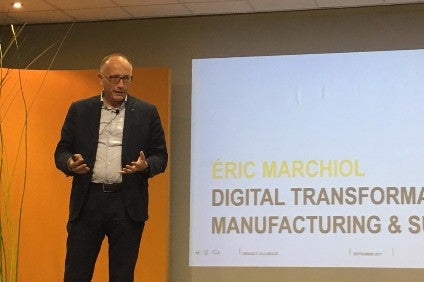
“We are hiring now in France, [we are] heavily investing in robots and they [staff] can see we are hiring,” Renault digital transformation VP, manufacturing and supply chain, Eric Marchiol told just-auto at the company’s Valladolid plant in northern Spain.
“We have invested more than EUR500m (US$590m) in France in productivity and 4.0 activity and we have started to hire – we have new people – it is the same in Spain.”
That EUR500m is capital expenditure between now and 2019 to improve plant performance through the use of flexible production lines, automation and the use of collaborative robots, as well as upgrading working conditions via renovation and improving workstations.
Collaborative robots are already a reality in the Valladolid plant and as the pace of their introduction across a multiplicity of industries starts to accelerate rapidly, attention is being focused on staffing implications.
However, anecdotal comments from Germany indicate while the country has around three times the number of robots as France, its unemployment rate is half that of its western neighbour, pointing to a future where the nature of work for humans will change, rather than the elimination of work itself.
“This is reality,” added Marchiol. “Robots or [a] mix is not cutting jobs, it is just enabling us to build more cars and more connected cars because there is an increase in technology in autonomous vehicles and we need to be more efficient. It is not only a speech, it is going live now.
“If you visited the factories of Renault five years ago, it would be a jungle of parts. Today you will see [in Spain] no parts because each part is kitted to each vehicle. This new activity enables us to leverage this efficiency, also operators can focus on value added. Now what he [operator] will have is full synchronisation and full knowledge, which for me is a real big shift.
“But we are doing it [4.0] because we think it is a real game changer, [as well as] of course for quality and flow optimisation. We are also using the reality for better training, how to use the new tools for training. I was in charge of production systems and the major challenge was to bring managers to understand it.
“I want managers to use the tools themselves so they can ensure tools [are] business-oriented. Managers have to lead that. That is why I do a lot of training with management to understand the mindset change.
“What is really enabled by new technology is interconnectivity of all operations. We have full interaction with our own legacy systems – the transformation of 4.0 is mixing all legacy applications.”
Renault’s recent CAP 2020 agreement saw the inking earlier this year of a deal to secure future performance for the next three years, looking to drive customer satisfaction, sustainable operations and employee motivation.
The manufacturer has committed to an eventual 3,600 permanent contracts and 6,000 fixed-term youth employment deals.




