
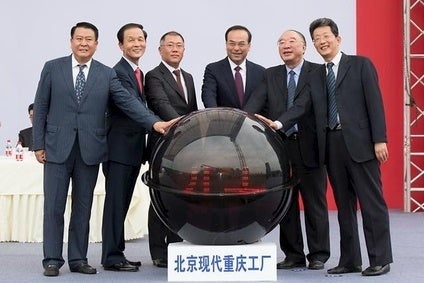
Hyundai Motor has broken ground for its fifth Chinese manufacturing plant – in the Liangjiang New Area of Chongqing.
The automaker’s vice chairman Euisun Chung said: “I am very pleased to build Hyundai Motor’s fifth plant in Chongqing, the heart of midwest China, where robust economic growth is taking place. We will utilise this plant as a means to establish a stronger market presence in western China, accelerating our plan to become a leading automaker in all regions of China.”
Go deeper with GlobalData


Discover B2B Marketing That Performs
Combine business intelligence and editorial excellence to reach engaged professionals across 36 leading media platforms.
The new plant is a US$1bn joint venture between Hyundai Motor and Beijing Automotive Group which operate the exisiting Beijing-Hyundai assembly and distribution operations in China.
It will be a 293,000 sq m factory built on a 1.87m sq m site with annual production capacity of 300,000 vehicles. Hyundai plans to produce a new C segment model developed for Chinese buyers and an SUV model in Chonqing where production starts in 2017.
A Reuters report noted Hyundai, which together with affiliate Kia Motors, ranks fifth in global sales, had been struggling with slow sales in China due partly to an absence of new SUV models to compete with its rivals’ latest releases.
“We have to acknowledge that we will see a lower growth rate and we will need to fend off new challenges from fast growing domestic Chinese automakers,” Chung said at the ground breaking ceremony.
Hyundai, which has failed to take advantage of a global SUV boom spurred in part by cheaper fuel, has previously said it was considering boosting production of the gas guzzlers to keep up with market growth, the news agency noted.
Hyundai will also expand its Chinese dealer network by 300 dealerships to 2,000.
Hyundai has two other plants under construction in China. Expected to begin production in 2016 and 2017, they will help Hyundai and Kia reach an annual combined capacity target of 2.7m vehicles by 2018, Reuters said.




