
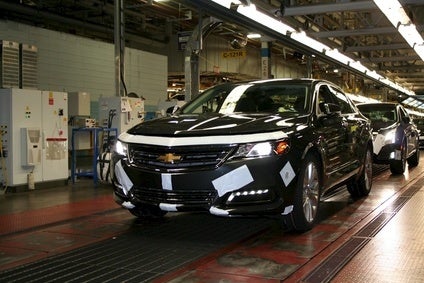
General Motors has said it remains committed to Canadian investments but made no specific promises about the future of its Oshawa, Ontario operations or requests for government assistance for Oshawa, Ontario Economic Development Minister Brad Duguid said after a meeting with GM chief executive officer Mary Barra, according to a local newspaper report.
Toronto’s Globe & Mail said Duguid and federal industry minister James Moore met Barra and General Motors of Canada president Steve Carlisle in Detroit amid fears that the automaker plans to stop building vehicles in Oshawa later this decade.
Go deeper with GlobalData


Discover B2B Marketing That Performs
Combine business intelligence and editorial excellence to reach engaged professionals across 36 leading media platforms.
“I am more optimistic having met with Mary Barra and Steve Carlisle today than I would have been prior to that meeting,” Duguid said. “We’re determined to land a future mandate for that plant.”
The GM executives and the Canadian cabinet ministers discussed how they can work together on future opportunities at GM’s operations in Oshawa, Ingersoll, Ontario, and St. Catharines, Ontario, Carlisle said in a statement.
“We underscored our ongoing commitment to Canada, which is one of our most important markets and high-quality manufacturing locations,” he said.
Jake Enwright, a spokesman for Moore, said the meeting was positive and the federal government looks forward to working with GM.
The Globe & Mail said questions about the future of the Oshawa operations had arisen because GM has allocated no new vehicles to one of the assembly plants that will replace vehicles that are being discontinued or shifted elsewhere. The other Oshawa plant is scheduled to close in 2016, the same year a production commitment GM made in 2009 expires.
Duguid said Oshawa’s future is his top concern in the auto sector.
The key issue for GM and other automakers is the cost of producing vehicles in Canada as assembly grows dramatically in lower cost countries. The costs of electricity, regulation, labour and transportation of finished vehicles to markets are among the factors.
Contract negotiations between the United Auto Workers union and the automaker about its USplants will be held this year, the report noted. Automakers typically compare the labour costs of their US plants with their Canadian operations when it comes to investment. The UAW-GM negotiations will be followed by talks between the company and the Unifor union in 2016.
Unifor president Jerry Dias said the drop in the value of the Canadian dollar improves the company’s cost position in Canada.
Barra said last week, however, that currency fluctuations would have no impact on production decisions. She called the drop in the loonie a fluctuation.
Canadian Imperial Bank of Commerce economists Avery Shenfeld and Andrew Grantham said the currency needs to stay in the US$0.80 to $0.85 range for several years before all the benefits of the lower currency show up in manufacturing.
Shenfeld said he disagreed the drop in the currency is a fluctuation if that word is taken to mean a short-term fall.
“While the weakness in oil won’t be permanent, we were already destined to see a significant and lasting move to a weaker Canadian dollar from what prevailed in the 2010-to-2013 period,” he said in an e-mail response to Globe & Mail questions.
Dias, whose union represents about 3,600 workers at the two Oshawa assembly plants, said the union heard about the currency regularly from executives of the Detroit Three auto makers when the dollar was climbing to par and higher against its US counterpart, so the companies need to recognise how the lower value of the currency will help them.




