
A former chairman of Toyota Canada is chairing a new committee to promote the province of Ontario to the automotive industry.
Ray Tanguay, a former chairman of Toyota Canadian operations said to be one of the sector’s strongest advocates, will chair the committee formed by the province, the Canadian Automotive Partnership Council (CAPC) and the federal government to help the region maintain its leadership role in the global auto market.
Go deeper with GlobalData


Discover B2B Marketing That Performs
Combine business intelligence and editorial excellence to reach engaged professionals across 36 leading media platforms.
“The committee will provide advice, make recommendations to market Ontario’s auto assets and identify opportunities for strategic and long term investments to secure Ontario’s auto market success,” a statement said.
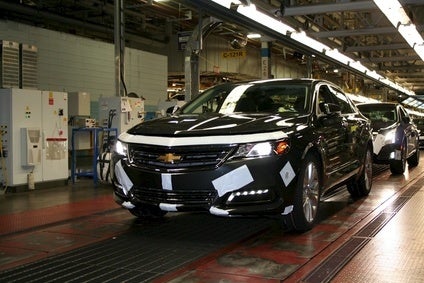
Chrysler, GM, Ford, Honda and Toyota all operate Ontario assembly plants while key suppliers include Linamar and Magna. But there has been much speculation recently over the future of GM’s Oshawa plant, now sharing Impala production with Detroit Hamtramck and which has lost the next Camaro to Lansing. It recently had its planned #2 plant closure in mid-2014 put back to 2016 (when the automaker is expected to make a decision on the site’s future following pay negotiations with the key US and Canadian unions). A recent CBC report said the plant employed about 15,000 workers in 1987 but just 3,600 remain today and another 1,000 jobs go in November when current Camaro production ends.
The committe statement said the automotive industry contributed $16bn to Ontario’s GDP in 2014 while its assembly plants produced nearly 16% of North American vehicle production over the last five years. It is also the only sub-national jurisdiction to have five major global automotive assemblers plus truck manufacturer Hino.
Chairman Tanguay will also advise governments and business.
“The committee will provide both governments with strategic advice in the attraction of incremental automotive investment in the province while positioning Ontario’s automotive sector for long-term success,” the statement said.
“Ontario’s auto sector is a cornerstone of our economy — a key source of our ability to export, innovate and create jobs. In this highly competitive global economy, we need to drive further investment and ensure the sector remains strong. I am confident that this new partnership, with Tanguay’s strategic advice and leadership, will allow Ontario to increase our competitiveness, productivity, and market share in the auto sector, and I look forward to their important work contributing to a more prosperous, innovative Ontario economy,” said economic development minister Brad Duguid.
The committee will be comprised of “seasoned auto executives from major auto companies with operations in Ontario”.
The committee acknowledged the province “is intensely competing for new auto investments against several low wage jurisdictions, who continue to provide lucrative incentives to businesses”.
That clearly refers to southern US states, with their anti-union policies, and also Mexico, to which Toyota eventually will shift Corolla production currently carried out in Ontario, and also the US.
The start of Corolla output in Mexico in 2019 will affect the automaker’s NAFTA production north of the border. Once the Mexican factory is up and running, Toyota Motor Manufacturing Canada (TMMC) will switch its Cambridge, Ontario North plant from the Corolla sedan line to “mid-sized, higher-value vehicles”, the automaker’s first major spend on the plant since it opened in 1997.
Toyota said it would also make “significant new investments over several years” in TMMC’s assembly plants in Cambridge (also the only factory outside Japan to assemble the Lexus RX SUV line) and Woodstock, Ontario (which currently builds NAFTA market RAV4 compact SUVs) to implement TNGA modifications, maintaining the Canadian factories’ importance as a strategic manufacturing hub.
Toyota said the TNGA changes at these plants would require major modifications to the two assembly plants in Cambridge and the one in Woodstock. These projects would take place over the next several years.
The Woodstock plant would continue to manufacture the RAV4, a vehicle competing in a rapidly growing segment. The Cambridge South Plant would continue to build the Lexus RX 350 and 450h, the newest models of which were recently unveiled.
“This commitment to Toyota manufacturing in Canada is a huge vote of confidence in our [workers],” said Brian Krinock, president of TMMC, last April. “With a new platform, new products and new technology, Toyota’s continued investments in Canada will take us to the forefront of advanced manufacturing, further drive our competitiveness and position us for sustainable success.”
Canada has lost 14,300 automotive assembly jobs since 2001, most of them in Ontario, the CBC report said, citing the Automotive Policy Research Centre. Another 38,900 jobs have disappeared in the parts sector.
Auto analyst Tony Faria was quoted as saying Oshawa had gone from making almost 900,000 cars a year in 2000 to 277,000 a year by 2014.
“We badly need a new vehicle announced for Oshawa,” he said.
GM has said it remains committed to Canada, and is hiring for R&D jobs, but is not committing to anything for the plant until it wraps up union contract negotiations next year.
In a recent statement, the automaker said:””GM Canada continues to examine a range of longer-term opportunities and competiveness enhancements for Oshawa Assembly working with Unifor, government, supplier and community partners to ensure our operations are as innovative, efficient and cost competitive as they can be. Future product decisions will not be made until after Unifor national bargaining, scheduled for 2016.”
Faria told CBC: “If they don’t get a favourable contract, that could well spell the end of the assembly in Oshawa.”




