
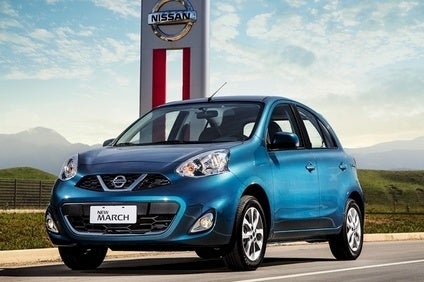
Compact hatchbacks are strongly represented in Brazil’s light vehicle market, accounting for nothing short of 45% of sales.
This is the reason Nissan focused on this segment as a way to accelerate its plan to expand and become Number One amongst the Japanese brands in Brazil. Not an easy task but the early mistake of depending only on imports of the pre-facelift version from Nissan’s Mexican unit was fixed by building the updated car locally in the new Resende, state of Rio de Janeiro plant which includes an engine factory.

Discover B2B Marketing That Performs
Combine business intelligence and editorial excellence to reach engaged professionals across 36 leading media platforms.
The automaker took care in price positioning the lightly refreshed March (Micra in most other markets outside Japan) quite wisely from BRL32,990/US$14,900 (one-litre/61 cu in engine) to BRL42,990/$19,400 (1.6-litre/97.6 cu in). The former model will still be imported from Mexico [the free trade agreement remains in place – ed] but now priced a little lower.
Brazilian March styling has been improved, especially the new nose (with new corporate chrome grille highlight) and centre console. Slight dimensional changes did not alter the already good passenger room nor increase the previous model’s modest fuel tank of just 41 litres/nine imperial gallons. The excellent, 9 m/29.5 ft turning diameter and – now rare – rear windows that roll down fully, were retained.
The rich standard equipment list, from base version up, demonsrates an aggressive perceived-value strategy: air conditioning, electric power steering, on board computer, vanity mirrors on both sun visors, boot lighting, console-mounted 12-volt outlet (rather weirdly placed), height adjustable driver seat and steering wheel plus front seat belts with pre-tensioning and braking assist (on top of antilock brakes).
It is the only compact car ever to offer a rearview camera here, albeit only in the top version. Nissan wisely decided to fit known brand, Brazilian-made tyres instead of the imported Mexican cars’ Chinese rubber.
The one-litre engine is a Renault-designed, previous generation Alliance-shared unit and Nissan Brazil claims it’s the market’s most fuel efficient with air conditioning in use. However, power (73bhp) is far below (10%) the VW Up’s 81bhp and Renault’s newer 79bhp version of the engine sold in its own models here. As for the 1.6-litre Nissan 109bhp engine, it is far from brilliant, especially below 3,000 rpm, but the car’s low weight (956 kg/2,108lb-982 kg/2,165lb) does help.
Sound deadening has been improved yet any gain is not easily perceived. First gear remains as noisy as before as if spur, rather than helical, cogs are used in the transaxle and the steering column which drops sharply suddenly when adjusted was also carried over. Suspension travel was increased by a slight 1cm/0.4in for the top 1.6SL version to cope better with uneven roads on its larger 16in wheels.
Handling is as good as before.



