
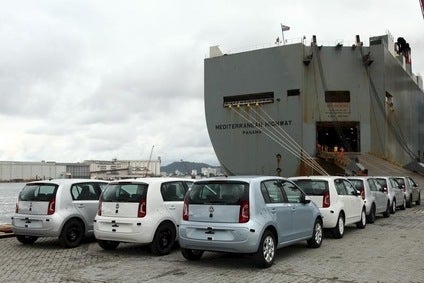
The automotive accord between Brazil and Argentina within the Mercosur trade bloc has just been renegotiated for a year to July 2015.
So called ‘flex’ was renewed, fixing the exchange rates in US dollars, at an amount less favourable to Brazil than before.
Go deeper with GlobalData


Discover B2B Marketing That Performs
Combine business intelligence and editorial excellence to reach engaged professionals across 36 leading media platforms.
In recent years, Brazilian cars accounted for 45%-50% of the Argentine market and imports from Argentina accounted for between 10% and 15% of sales here. Under the free trade rule envisaged by Mercosur when the trade bloc was created 23 years ago, many disputes between both countries could have been avoided.
There is already a sound complementary industrial scheme which concentrates production of compact models in Brazil and mid-size vehicles in Argentina, with a few exceptions. Yet there is an imbalance in the auto parts industry caused by Brazil’s far greater production volume.
Nevertheless, opportunity windows are opening.
In this second half of 2014, Mercosur will at last sign an accord with the European Union to set a 15-year deadline for a gradual reduction of all import quota and duty barriers on vehicles. This will consolidate the current process of technological updating of this region’s products.
Second window: March 2015 will see the three-year period of quotas for imports from Mexico coming to an end, thus resuming the free trade halted in 2012.
Therefore, a climate of the unconditional opening of the Brazilian and Argentine borders is created. There is even the possibility of a joint industrial regime to try to improve export conditions for both countries. But it would depend on major elections here (2014) and in Argentina (2015) because, if opposition parties win, different views of excess interventions in the economy may prevail.
It is interesting to mention pricing convergence in both countries. Historically, taxes were lower in Argentina, yet a recent tax super-hike (focused on upscale models) affected all products.
The VW Up launched this week in Argentina starts at the equivalent of BRL30,900/US$13,800 compared with BRL27,000/US$12,000 here. Even with full Brazilian IPI excise tax, due to be back in force by the end of this year, the VW will remain higher priced in Argentina because cars powered by one-litre engines are taxed less in Brazil.
So, finally, will Brazil and Argentina, after two decades, agree the sought-after free trade?




