
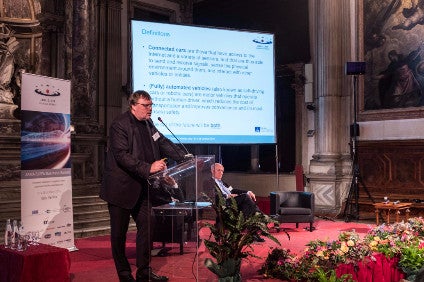
One acadaemic is stressing the need for autonomous vehicle research not just to concentrate on the undoubted heavy content needed for autonomous vehicle, but also the effect of the phenomenon on societal mobility.
Much focus is currently lasered in to the huge leaps in technology required for autonomous or even semi-autonomous cars, but of equal importance could be how the new thinking will alter the urban and rural transport landscape, particularly from a government perspective.
Go deeper with GlobalData


Discover B2B Marketing That Performs
Combine business intelligence and editorial excellence to reach engaged professionals across 36 leading media platforms.
“The UK, Germany, Holland, are thinking about all things, about who [can] bring us from point A to point B,” said HTW Saar (Saarbrucken University of Applied Sciences) Professor Horst Wieker at the recent JAMA-CLEPA Business Summit in Venice. “At level 4 and 5 [autonomous driving] we need some plan from the government.
“We have to keep [in] mind we have not to [just] think about products and content – we have to think about the effects – smart grid – smart traffic. When the next 100kw car comes and it charges in 2h and you have a car park with 100 cars, then you have the same [capacity] problem.”
Wieker is a member of a German government commission charged with evaluating the impact of autonomous technology and its impact on traffic and economics, but which as well as academics, includes automotive manufacturers, suppliers and road operators.
“It is clear we need information about traffic if we want really to go into level 5 driverless,” added Wieker. “We are concentrating now on level 5. If you take 50 cars in an old German town with many one way streets, after 20 minutes you have a traffic jam.
“Six German cities want to set up test fleets for autonomous driving; in Düsseldorf, Dresden, Munich, Hamburg, Ingolstadt, Braunschweig. We will test new communication systems, G5 and the internet of things.
“Computers are used to take over certain tasks such as braking and tracking assistants, where you can take your hand off the wheel for a while. By 2020 the Federal [German] government is providing EUR80m (US$86m) as research funding.
“We have many different States in Europe with different regulations. It is clear when I buy a car in The Netherlands, I want to drive with the same functions in Germany too.”
Wieker also noted in 1478, Leonardo da Vinci had already sketched plans for a driverless cart.




