
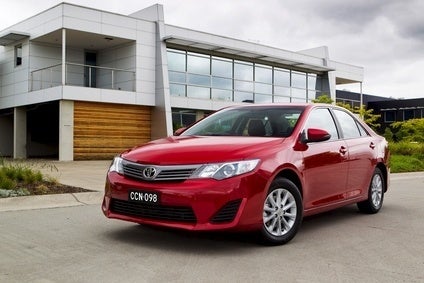
Sales of the Camry – which will be the final Toyota model built in Australia when car and engine production end in 2017 – have passed the 850,000 mark.
The model was launched in 1983 – Toyota Australia’s first front-drive model – and build in Melbourne commenced in 1987 with the two-litre engine, most body panels and many other major parts made locally. The Camry also became the automaker’s first export model when shipments of station wagon versions began to New Zealand. That country remains Toyota Australia’s top export market.
Go deeper with GlobalData


Discover B2B Marketing That Performs
Combine business intelligence and editorial excellence to reach engaged professionals across 36 leading media platforms.
Top selling Toyotas Down Under are the LandCruiser (launched in the 1950s following private imports used on a major hydroelectric dam construction project), Corolla (launched 1967), HiLux and HiAce (1971), Coaster (1977) and the Camry and Tarago (1983). The Tiara, a predecessor of the Corona and Camry, was the first Toyota car assembled outside Japan when production – contracted to Australian Motor Industries, started in 1963.
The Camry is now within a few weeks of notching up its 21st consecutive year as Australia’s best-selling mid-size car.
With its name derived from the Japanese kan-muri which means ‘crown’, the Camry has established itself as a true global car with more than 15m sold worldwide.
It was developed in the wake of the oil shocks of the late 1970s, meeting a global need for spacious cars powered by engines designed to beat soaring fuel costs and comply with stricter fuel-efficiency regulations.
The Camry was introduced to Australia as an import from Japan in liftback guise in 1983, winning several local ‘best car’ awards.
Australia was the first Toyota affiliate outside Japan to build the model when it started assembly of the second generation which was also built as a sedan and later added an imported V6 variant to the local I4-engined line.
In February 1993, the US-style ‘wide-body’ Camry was launched by then prime minister Paul Keating, who described the car as “another quantum leap in the history of the Australian automotive industry”.
Larger in every dimension than the previous model, it became classified as ‘mid-size’ and soon became Australia’s best-selling medium car – a title it has held ever since.
The fourth generation was introduced in 1997 and was quieter, lighter and more powerful, with better ride quality and improved handling.
The fifth generation, launched in 2002, was the result of a A$350m development programme and featured significant local development, including brakes, headlamps, electronics and suspension calibration.
The sixth-generation from 2006 featured major improvements to interior space, performance and driveability while maintaining its fuel economy. It had greater structural rigidity, more active and passive safety features, improved comfort, lower noise levels and reduced emissions.
The nameplate Camry made Australian history in 2010 with the introduction of the country’s first [and still only] locally built hybrid car. It was also the first Australian made car to combine electric power steering, electronic brake control, regenerative (electric) braking and electric air conditioning.
The current generation was unveiled in 2011, powered by a new 2.5-litre I4 engine and six-speed automatic transmission, along with improved driving dynamics, a more spacious cabin and expanded safety features.
It was joined in early 2012 by the redesigned hybrid with maximum power jumping almost 8% to 151kW. Fuel economy improved by more than 17% on the Australian city test cycle.




