
The 37th Bangkok International Motor Show got underway this week at the “Impact” exhibition centre near the old Don Muaeng airport on the outskirts of Bangkok. Tony Pugliese reports for just-auto
The event organiser, Grand Prix International, said one of the key focuses of the local automotive industry at the moment is compliance with global technology standards – as it looks to maximize global market opportunities.
Go deeper with GlobalData


Discover B2B Marketing That Performs
Combine business intelligence and editorial excellence to reach engaged professionals across 36 leading media platforms.
The automotive industry itself is clearly cautious on the short-term prospects for the local market, with Federation of Thai industries expecting a fourth consecutive year of decline this year – of around 5-6% to 750,000-760,000 units. These views are mirrored by some of the largest vehicle manufacturers, including Toyota – which accounts for around one third of the total market.
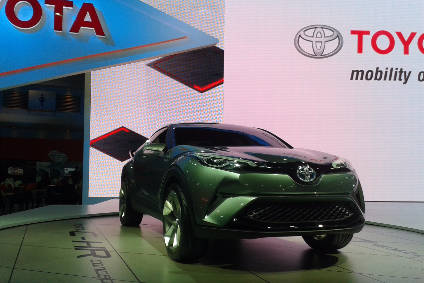
Toyota at the show had little on offer to attract new interest in the market, other than the Hilux Revo – a specked-up version of the country’s best-selling model. Several important new models launched last year were on display, however, including various body-types of the Hilux, the new pickup-based Fortuner SUV and the face-lifted Yaris sub-compact car – which was also launched last year. Its main show-piece was the C-HR hybrid SUV concept.
Similarly, Mitsubishi‘s stand featured models mainly launched launched year, including the new Pajero Sport SUV which went on sale last August and the Triton pickup truck, launched almost a year and a half ago. Isuzu‘s centre-piece was its pickup based SUV, the MU-X, launched almost a year ago.
Mazda displayed its face-lifted CX-5 SUV, launched in the local market in February, the all-new CX-3 launched last November and the new MX-5 roadster launched in December.
More upbeat sentiment came from Honda, which showcased the 10th generation Civic compact passenger car that went into production at a newly-built production facility earlier this month. Also making its debut was a face-lifted version of the Accord, while the new BRV compact SUV – launched in November, was also displayed prominently.
The new 1.5L Ford Focus made its Thai debut at the show, with deliveries scheduled to start in June. It will also be exported to other markets in South-east Asia, as well as to Australia and New Zealand. Hyundai showcased its facelifted Grand Starex and H1 minibuses – imported from Indonesia.
Subaru launched the all-new Forrester SUV, which it mainly imports from Malaysia. It hopes to sell 3,000 of these in Thailand this year, lifting overall annual sales to around 8,000 units.
Nissan‘s main news was the launch of its Nismo high-performance brand to help lift the brand’s overall image in the country. The company showcased the 600-horsepower Nismo GTR model, but unfortunately for Thai speed enthusiasts it will not be made available locally. A Nismo version of the Almera will go on sale in Thailand, however, complete with spoilers and other body variants. But unfortunately again for Thai speedsters, the car will have to retain its original engine as the Almera is an eco-car.
China’s SAIC group, which operates in Thailand under the MG brand, launched the new GS compact SUV – fitted with an all-new 2.0L aluminium turbo-charged engine. It hopes to sell 1,000 of these in Thailand this year, competing had on with the Mazda CX-5. A 1.5L version will be launched later this year. The company has set itself an overall wholesale target of 13,000 units in Thailand this year, and 10,000 retail sales.
Luxury segment continues to grow
While automakers in the high-volume segments are downbeat about the prospects of an imminent domestic market recovery, luxury brands such as Mercedes-Benz and BMW are a happier bunch.
Mercedes-Benz sold a record 12,800 passenger vehicles in Thailand last year, which according to the company accounts for around 52% of total luxury segment sales. General manager for marketing, Atch Bunyaprasit, expects the luxury segment to continue to expand in 2016 – albeit with single-digit growth.
The company launched the new E-class model, fitted with a newly-developed 2.0L diesel engine, and expects to begin local assembly of this model within a year. Petrol versions, which are in short supply globally at the moment, will be launched as they become available. Also launched at the show were the GLS SUV and the AMG A45 and C63 coupe models.
New excise duties introduced at the beginning of the year in Thailand, based on fuel consumption and exhaust emissions, have helped to make the latest luxury models cheaper in Thailand, says Khun Atch. The E-class range is expected to be the main driver of growth in Thailand this year – despite being available only as a CBU import.
Mercedes also displayed the locally-assembled S500e and C350e plug-in-hybrids for the first time.
Sales of plug-in hybrids also have been incentivized by lower taxes. Kuhn Atch said hybrids now account for around 45-50% of S-class and C-class sales in the country and are expected to eventually account for a similar proportion of new E-class sales once the full model range is available.
BMW was more cautious about the prospects for the luxury segment, but director of sales and marketing Lars Nielsen said the he expects the overall segment this year to be “at worst” unchanged from last year.
The brand’s main launches at the show include the M2 performance saloon, for which there is a 10-month waiting list, the 330e hybrid executive saloon and the 730Ld diesel model. BMW also launched two limited edition models to celebrate its centenary anniversary.
The Mini Coupe S convertible, imported as a CBU, was also launched at the show –helping to strengthen a line-up which includes the ageing Countryman model.
Toyota’s Lexus division launched the new RC200T, while Volvo’s centrepiece was its XC90 plug-in hybrid SUV.
At the exotic end of the market, Porsche launched its new 911 model, Aston Martin brought in the stunning DB11 and Lamborghini its new V10-powered Huracan.




