
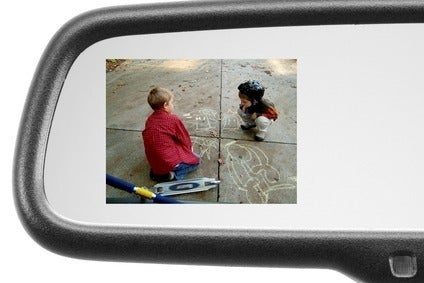
The rearview mirror has been transformed over the last decade into a high-tech electronic module, writes Matthew Beecham. Tomorrow’s mirrors will feature even more, including lights, cameras, displays and controls.
While more and more features are being packed into rearview mirrors, embedded camera technology is developing quickly. Going a step further, US-based App-Tronics used last year’s SEMA show to demonstrate its SmartNav 5, bringing the capabilities of a Windows CE computer into the interior rearview mirror. It projects a five-inch translucent touch screen in the centre of mirror providing features such as sat-nav, video recorder, bluetooth phone connection and, of course, a range of apps.
Go deeper with GlobalData


Discover B2B Marketing That Performs
Combine business intelligence and editorial excellence to reach engaged professionals across 36 leading media platforms.
In terms of what else can we expect to see packaged into either the exterior or interior rearview mirror, David O’Connell, Vice President – Global Engineering and R&D, Magna Mirrors & Magna Closures predicts further growth and increased market penetration of these features, especially lights, cameras, displays and controls. He told just-auto: “The majority of camera growth is with the outside mirror, since our OEM customers are tending to decouple the camera from the inside mirror.”
Meanwhile, the auto-dimming mirror market has shown phenomenal growth over the past decade. Interior auto-dimming rearview mirrors are already available on a variety of vehicle models, from the Toyota Camry to the BMW 7 Series. Increasingly, such mirrors are being fitted to small- and mid-sized vehicles.
While auto-dimming rearview mirrors have their obvious benefits, they are still expensive. O’Connell notes that some OEMs (Honda, for example) have used blue glass as an alternative to auto-dimming. “However, the use of blue glass has declined in recent years. While no other alternative technologies have entered the marketplace, Magna is always investigating new technologies for the auto-dimming mirror.”
Given that wing mirrors add weight, cost and wind resistance (at high speeds) to the car, it is not surprising that some automakers wish to eliminate them. While it is reasonable to assume that by the end of the 2020s mirrorless cars would be commonplace, motorists need time to get used to the idea. Camera technology needs to improve by then, too. For instance, such cameras need to be able to record good quality video at high speeds – and in all elements – in order to present a crisp vision of what is in the driver’s rearview.
Jaguar Land Rover’s (JLR) research team is looking at technology that could replace rearview and external mirrors with cameras and virtual displays. Using two-dimensional imaging to replace mirrors is limited by the fact that single plane images on a screen do not allow the driver to accurately judge the distance or speed of other road users. JLR has therefore developed a novel 3D instrument cluster, which uses head- and eye-tracking technology to create a natural-looking, specs-free 3D image on the instrument panel. Cameras positioned in the instrument binnacle or steering column area track the position of the user’s head and eyes. Software then adjusts the image projection in order to create a 3D effect by feeding each eye two slightly differing angles of a particular image. This creates the perception of depth which allows the driver to judge distance.
Meanwhile, Nissan’s so-called Smart rearview mirror combines the use of a rear facing camera and LCD screen to display a clear view of the road behind the driver, regardless of anyone or anything sitting in the back of the car that might otherwise obstruct the view. The driver can switch between the digital view display or traditional rearview mirror, depending on his or her preference. Nissan claims its technology is especially effective in low-light conditions, like in parking garages and during night driving where it helps to reduce glare.
Continuing the digital theme, Audi’s vision is demonstrated in its R18 Le Mans prototype that has no rear window. Instead, it features a digital rearview mirror. A small camera located at the rear of the car relays images to a 7.7-inch digital screen in place of the interior rearview mirror. This technology could trigger more styled supercars to eliminate the rear window.
As for tomorrow’s mirrors, back-up cameras have already been regulated while Tesla (and others) are calling for more flexibility on mirror requirements which date back to a rule made in 1968 (in the US, at least). But changing these rules will take some time and effort. Mirrorless trucks could come sooner, though. In May 2015, Daimler Trucks North America petitioned the NHTSA requesting camera-monitor systems as a compliance alternative to rearview mirrors.
The latest developments in the OE mirrors sector can be followed on just-auto’s automotive research platform, QUBE




