
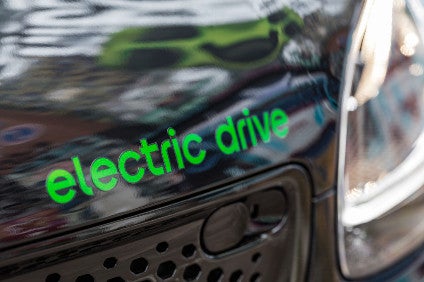
Automakers around the world have stepped up their efforts to expand into the new-energy vehicle (NEV) segment, in what is being described as the most far-reaching overhaul of the global automotive industry in many decades.
Many billions of dollars are being earmarked by the industry to develop and produce replacements for conventional internal-combustion engine vehicles over the next decade.
Go deeper with GlobalData


Discover B2B Marketing That Performs
Combine business intelligence and editorial excellence to reach engaged professionals across 36 leading media platforms.
Earlier this month Toyota Motor’s president Akio Toyoda said at a conference “the global automobile industry is going through a sweeping change seen only once in a century”.
The main driver of these sweeping changes is China, where the government in September announced new environmental policies, including mandatory sales quotas designed to quickly drive up NEV sales in the country.
China overtook the USA in 2010 as the world’s largest vehicle market and has not looked back since.Total vehicle sales are expected to be in the region of 29 million units this year – or approaching one-third of global sales.
With such an important market, it was inevitable that domestic Chinese policies would begin to influence the development the global auto industry. Chinese cities are among the most polluted in the world and the government is under more pressure than most to cut emissions.
NEVs sales in China are expected to reach 700,000 units this year and to exceed 1m units in 2018, with battery-powered electric vehicles (EVs) accounting for more than 80% of these. The remainder includes mainly plug-in hybrid vehicles (PHEVs), while sales of others types such as fuel-cell vehicles are negligible.
This makes China by far the largest EV market in the world, with the gap expected to widen significantly in the coming years.
The Chinese Government in September announced revised policies that target in excess of two million NEV sales by 2020, based on an energy scoring system mandatory for companies with more than 30,000 annual vehicle sales.
The government plans to rely less and less on incentives to stimulate NEV demand and instead will require automakers to meet every-rising minimum quotas. Those unable to comply will be required to purchase credits or pay heavy fines.
To help drive demand for NEVs, government departments will be required to switch purchases to NEVs where possible, while banks will be required to offer improved financing terms to consumers. Buyers will also have automatic entitlement to licence plates and privileged access to city centres and parking.
Ultimately the government wants to establish a globally-competitive NEV industry targeting mainly consumers. It sees improving economies of scale for key technologies, particularly batteries, as key to its policy success.
The industry widely expects sales of conventional combustion-engine passenger vehicles in China to be phased out by 2030 – sooner than any other country in the world.
Governments in Europe, including France, the UK and the Netherlands, have also announced timetables to phase out sales conventional combustion-engine vehicles, but these are understood to be further in the future –2035 or 2040. Here, markets are expected to more heavily favour hybrid technology.
German automotive consulting group Roland Berger recently said it expects global “green” vehicle sales to exceed 23 million units by 2025, up from 2.35m units last year.
In the last few months most global vehicle manufacturers have rushed through new global product plans in response to these new regulations.
Toyota is the latest to announce a major overhaul in favour of electrified powertrains. It is looking for NEVs to account for at least 50% of its global sales by 2030, from 15% at present. Of the 5.5 million NEVs it plans to sell by 2030, 4.5 million are expected to be hybrids and 1.0 million EVs and hydrogen fuel-cell vehicles.
The company this month also announced an alliance with Panasonic to produce and recycle batteries, while in September it unveiled a broad-based EV alliance with Mazda.
Earlier this month Hyundai Motor announced plans to expand its range of “green vehicles” to 38 models by 2025 from the current 13 models, including 14 pure electric vehicles. These plans will likely be mirrored by sister company Kia Motors.
Like Toyota, Hyundai will focus on EV, hybrid and fuel-cell technology. While the company sees the latter as a more long-term solution to cutting vehicle emissions, it plans nevertheless to unveil a new fuel-cell electric vehicle with a range of 590km in early 2018.
One of the key areas of focus in the short term will be on pure electric vehicle technology, with 14 models expected to be on offer by the company by 2025. The group plans to launch an EV version of the newly-launched Kona SUV next year with a 400km range, followed by an electric Genesis car with a 500km range.
Ford recently announced plans to introduce 15 new electric vehicle models in China by 2025 through a new joint venture with Anhui Zotye Automobile, while Volkswagen Group also said it will invest more than EUR10bn with its Chinese partners by 2025 to develop and produce up to 40 NEV models in China.




