
The NAIAS in mid-January will mark the official start to the next wave of vehicle launches in the US. So what are the major OEMs readying for the 2016 model year? First, we examine the Detroit Three.
Aside from the ongoing Takata airbag recalls, the price of gasoline is THE big topic of recent weeks for the North American market. Most analysts seem to think any surge back up towards US$100 a barrel is unlikely, for now at least. American consumers time and again show that when pump prices fall, they fall in love with trucks once more, and ergo, they lose the love for cars. And we saw that in November, when truck sales rose by 9.0% but car sales fell back by 0.1% in a rising market.
Go deeper with GlobalData


Discover B2B Marketing That Performs
Combine business intelligence and editorial excellence to reach engaged professionals across 36 leading media platforms.
We’re also seeing some changes in segmentation. That’s not to say the Camry and Accord battle won’t continue to play out in 2015 and 2016 but certainly we’re not seeing these two mid-sizers dominating the top ten car sales rankings as they once did.
Another change that cheaper gasoline has brought is more generous incentives from some vehicle makers, mostly the ones selling older trucks and SUVs. There’s certainly going to be a lot more people and energy firms buying heavy duty pick-ups, thanks to the ongoing shale energy boom. So which vehicle makers stand to gain the most?
General Motors
GM finds itself in a good place right now. Vehicles such as the Chevy Silverado heavy duty pick-up series can often bring in tens of thousands of dollars of profit, depending on how heavily optioned up they are. Even with a lot of cash on the hood, the Silverado and its GMC Sierra twin are big money spinners. They’re also doing very well just now, with Ford having one hand tied behind its back as it slowly and very carefully ramps up production of the 2015 F-150. Added to that, the market knows Ford is planning to start building a new generation of its F-Series Super Duty trucks from around this time next year, so there will be some big incentives needed as 2015 goes on to keep the current Super Duty models selling well.
Underlining just how different GM is compared to its pre-bankruptcy self, it hasn’t bet the farm on high-margin trucks all over again. The rest of the world’s Chevy Trax is new for the US and Canada’s 2015 model year and it’s good to see General Motors being ready for what could well be a surge in sales of small SUVs. That’s going to affect cars like the Chevy Spark and Sonic but these are coming to the end of their lives in any case. Having said that, in the SUV segment above the Trax, GM has the Chevy Equinox but it has another year, possibly two, to go before it’s replaced (a mild facelift should debut at the NAIAS). That’s not ideal but it’s something that American Honda is pretty happy about. More on that in the second part of this series.
Again, showing that GM is being mostly very well run these days, there are other plans for a possible spike in energy prices in the form of a new Volt and also a plug-in version of the next Chevrolet Sonic: the second of these will be the effective replacement for the Spark EV. It also shows that compared to Ford and FCA, GM isn’t just going for compliance cars. And incidentally, don’t expect a repeat of a big sales forecast for the next Volt: that lesson has been learned. Job 1 for the 2016 Volt is on target for August next year.
A model that’s going to make a lot of money if the market likes it is the new Camaro and this is not only the Mustang’s worst nightmare but it’s got to be giving FCA some big worries too. The 2016 Camaro will use the Alpha architecture and that means better capacity utilisation for Lansing, as it’ll be built along the Cadillac ATS and CTS.
One last note on General Motors: never forget how much cash the Chevrolet Express and GMC Savana generate but the Ford Transit series is attacking these vans very successfully. I believe GM has made a big mistake by not dedicating resources towards some urgent replacements for these old vans.
Ford Motor Company
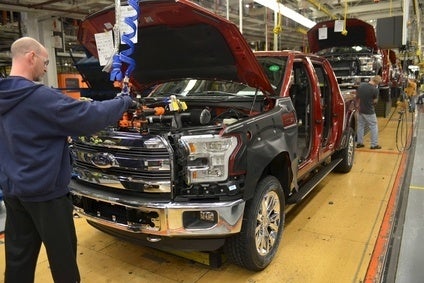
P552 is now in production at Dearborn Truck and a lot of money was spent on retooling that plant. Kansas City is having that treatment at the moment and it comes back on line in Q1 so it won’t be until March or so that Ford is at full capacity building the F-150 pick-up. If buyers like the idea of an aluminium truck, that’s going to have paid off. But it IS a risk and all of Ford’s rivals will by contrast continue to be selling light duty trucks with steel panels and pick-up beds. Maybe they’ll need to put heavy incentives on them to compete with the Ford, maybe they won’t.
P558 is about a year away and this is arguably more important than the F-150 as the Heavy Duty or as Ford terms them Super Duty trucks are just so profitable. These will move onto the same P3 architecture as the new 2015 F-150 and Ford will be hoping that traditional buyers won’t shy away from replacing their current Super Duties with what might be seen by some as a radical redesign.
If the Detroit Three are to meet the ever more demanding fuel economy standards (the EPA has mandated 30.2mpg by 2025), then they have to get the weight out of their trucks and big SUVs. One note of caution. Despite all of Ford’s marketing and ad campaigns, we mustn’t lose sight of the fact that the new F-150 isn’t THAT light, and for the moment at least, the era of the 30mpg truck isn’t yet with us. Further, from a supplier’s point of view, Alcoa is vital for Ford, and had to build a big new production plant for the F-Series’ body panels.
Ford finds itself in the ridiculous situation of being about to miss any boom in sales of small SUVs. It’s ridiculous in that the whole idea of One Ford is to get vehicles to market more quickly than had once been the case. Why isn’t the EcoSport being made in North America? And why, for that matter, is Ford of Europe’s best selling Fiesta having to stay in production for longer than is ideal? One Ford.
The company would counter this criticism by pointing out that B-SUVs are not a big part of US market sales for any manufacturer and it would be correct to do so. But it seems an unnecessary risk to take when the firm is so keen to connect with the next generation of US consumers.
The new Edge and to a lesser extent the next Taurus will be the big new models in 2015, and also expect mid-life facelifts for the Fusion, Focus and Escape.
Fiat Chrysler Automobiles
Now let’s take a look at what FCA has its new product pipeline. Well, the answer is, quite a lot, but not just yet. Luckily, Jeep is bringing in the big bucks and there seems no reason why that won’t continue into 2015. US market sales were up by 27% in November thanks to the Grand Cherokee and Cherokee, each of which has now sold over 160,000 units for the year to date.
With Ford selling out the last of its 2014 F-150s and the new-shape model in limited supply, the Ram 1500 series also had a record November. But a word of warning: the Jeep Wrangler and Unlimited have to last until 2017, by which time they will be very old. Also, the Dodge Grand Caravan won’t be renewed until 2016 and FCA is taking a huge bet on giving up over 100,000 units a year by discontinuing the Town & Country at the same time and replacing it with a crossover. Toyota and Honda will be loving the opportunity to expand Sienna and Odyssey sales when that happens.
There’s an unfortunate situation with the Dodge Challenger in that it is being allowed to become elderly at the worst possible time: the new Mustang is selling well and the next Camaro will be with us in 2015, as mentioned. Chrysler will have little choice but to throw generous and profit-destroying incentives at the Challenger in 2015. It’s going to be a long three years waiting for the replacement model and let’s hope there’s a convertible this time around – another strange oversight by Chrysler.
FCA should, on the other hand, be congratulated for having the 500X and Renegade ready to go if there’s a B-SUV sales boom but can there be much money in these models? They’re built in Italy which is all about keeping Fiat’s Melfi plant open rather than anything else. Globally, the US is probably going to be a small market for them, though – Europe, Brazil and possibly China and India too are where the majority of potential buyers are, so FCA is planning to build both in multiple locations.
One other important thought on FCA, which is the continued silence over the future of the Brampton plant in Ontario which builds Chrysler’s big RWD cars. The company has delayed their replacements until 2018 onwards so if that means one of FCA’s two Canadian production locations is going to be closed, there would be a major cost. Plus, there would then need to be a big spend somewhere else in tooling up for the new Giorgio RWD architecture. Toluca in Mexico would be the most likely location but all of this is speculative.
Check back next week to see the second part in this two-part series: Toyota, Nissan, American Honda and perhaps surprisingly, Subaru, and Volkswagen.




