
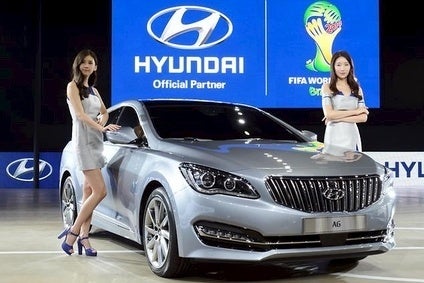
Hyundai is under attack at home. Not just from other Korean brands but in the premium segment too where Mercedes-Benz, BMW and Audi sales are surging. Will the new AG sedan be a big enough weapon with which to fight back?
Things are good for Hyundai Motor Company (HMC) but not great. As this investors’ presentation from March reveals, the company is rightly concerned by its inability to lift profits in the most recent financial year. The strong won is preventing a rise in Korean production but there are higher hopes for new or expanded manufacturing operations in the US, China and Brazil. The brand is also the main car sponsor of the forthcoming football world cup, which should give the firm’s image a boost in those parts of the world where it’s still seen as a niche player.
Go deeper with GlobalData


Discover B2B Marketing That Performs
Combine business intelligence and editorial excellence to reach engaged professionals across 36 leading media platforms.
For decades, HMC has been able to take it as a given that it faces no real threat to its market leadership in South Korea. Sure, every now and then a Kia model will top the sales charts but soon enough, incentives are thrown at the Sonata sedan and back it climbs into its traditional number one position. The seventh generation car, launched in Korea in March and then premiering soon after in the vital US market at the New York auto show, will no doubt pull way ahead of its nearest challenger as production ramps up. And yet, things are not all rosy for HMC. How else to explain why Kia’s 70th anniversary (this month) wasn’t marked? Could it be that the ‘junior’ company being older is something Hyundai can be touchy about?
Run your eye down the list of top ten best sellers in South Korea for April* and there, naturally, is the new Sonata in pole position, with 15,392 sales. There are three other Hyundai passenger cars – the Santa Fe, Grandeur (Azera in some markets) and Avante (Elantra) – but none makes it to the number two slot. Not only is that taken by the Kia Morning (Picanto) but Hyundai has no rival for this city car in the Korean market. Even worse, Kia had five cars in the top ten during April, versus four for Hyundai (the Chevy Spark came in at number six).
None of this would be of much concern to HMC had it not been for the other trend going on in its home market – the rise of both diesel cars and premium priced models. The Grandeur, only the fourth best seller in April, nonetheless remains Korea’s best seller of 2014, its 31,046 registrations just beating the Sonata’s 30,205 (the little Morning has 29,410). These big sedans will certainly be generating handy sums for HMC’s bottom line, as will the Santa Fe, of which 28,784 have been sold so far this year. It all seems fine until you look at the segments above where HMC has traditionally ruled.
“Amid tougher business conditions and fiercer competition, Hyundai Motor is continuously striving to provide products and services with solid fundamentals,” Kim Choong Ho, co-chief executive officer, said in a statement issued to coincide with the 29 May media preview day of the Busan motor show. “We place customer satisfaction before anything else, and the improved Grandeur and AG, introduced today, are at the centre of these efforts.”
The Grandeur of which HMC’s CEO speaks is already four years old, so likely to be past the high point of its sales cycle with the replacement not due until 2016. The “improved” model gains the expected nip and tuck to its styling but far more interesting than this is the arrival of a diesel version. Sales of compression-ignition engines, once rare in passenger vehicles in Korea, are surging. Hyundai and Kia obviously share the few diesels that they offer and are relatively well placed to exploit the ongoing trend. Kia’s new Carnival (the US and Canada’s 2015 Sedona) is also being launched at Busan and for this generation, it comes as standard with the same 202PS 2.2-litre E-VGT diesel as features in the new Grandeur.
Audi, BMW and Mercedes-Benz have all been selling up a storm in recent times with their TDI, d and CDI models. Now, HMC wants some of that business. But can it compete in local buyers’ minds with the prestige that comes with owning a German car? The signs are not entirely promising.
Korea accounted for 66% of the firm’s global premium sedan sales in 2013, according to HMC’s own data, and during the first quarter, sales of the new Genesis sedan were up by a factor of three. The firm’s website further states that deliveries of this high-end model rose by 23% YoY in Q1, and contributed to the first quarterly sales gain for the company in 12 months.
With a rise of just 4.5% for Q1, Hyundai is lagging its 6.4% sales increase goal for 2014. Obviously, that number doesn’t take into account the first full sales month for the new Sonata. Yet when Mercedes-Benz registrations are up by 45% and those for Audi rose by 54% in the same period (according to the Korea Automobile Importers & Distributors’ Association), it’s no wonder that the refreshed Grandeur now includes a diesel engine for the first time. Previously, there were only four- and six-cylinder petrol engines, as well as a four-cylinder petrol-electric hybrid.
Despite the arrival of the Grandeur diesel, no such equivalent exists in the Sonata line-up, which seems a major oversight. HMC stated at the time of the car’s launch that it aims to sell a total of 228,000 units (Korea: 63,000 / Overseas: 165,000) this year, while aiming to expand sales to 338,000 units (Korea: 89,000 / Overseas: 249,000) in 2015. Next year’s numbers no doubt take into account the first full year of US production, as well as build by Beijing Hyundai. Getting back to the question of taking on the Germans at home, why doesn’t HMC add the E-VGT to the Sonata? And why not also offer it in the US and Canada as a rival for the Passat TDI? Engines would have to be shipped to Chattanooga from Korea but why allow Volkswagen of America to control 75% of the market for diesel vehicles?
The premium cars strategy is developing but clearly Hyundai needs to beef up its offerings, while also working out what it wants the main brand, and Genesis, to be. At the top of the tree sits the big Equus limo which comes in two wheelbase lengths, and which is also sold in the US. Sales there are modest, but rising. So far in 2013, registrations total 1,203 cars, compared to 1,075 for the year to the end of April 2013. Genesis sales are down in the same period, however, despite last month being a record April for Hyundai Motor America, with 66,107 vehicles sold.
Back in Korea, the imported cars which are proving so popular with buyers are models such as the BMW 320d and 520d – BMW is the strongest foreign brand in this supposedly closed market with April sales of 3,625 units, followed by Mercedes-Benz (3,310) and Audi (1,980). Volkswagen, which is near-premium in South Korea, managed 2,609 registrations. Others? Ford was on 799, Lexus had 601, Land Rover 355, Jaguar 143, Infiniti 211, Volvo’s 218 beat Porsche by one unit, and Bentley sold 28 cars, which was two more than Cadillac was able to.
In light of the sales totals for the big three German premium nameplates, it’s especially interesting that HMC is yet to reveal more than the minimum of information about its crucial new AG (that’s the project code). Not even a model name, let alone engine details. This front-wheel drive D segment model looks good but there again, so do the cars it will be targeting, such as the Audi A4. Will it be a Genesis in any markets? For the moment, Hyundai isn’t saying, stating only what we already knew – that the AG will be launched during the second half of 2014.
That the company felt the need to reveal its new, additional luxury sedan at Busan is telling. In addition to eight domestic makes, a record number of foreign brands – 16 in all – are exhibiting at the BEXCO exhibition centre. Hyundai might be firmly in control of the overall market but when it comes to premium segments, it’s clearly feeling threatened. There’s a new generation of Koreans who want to be different, and so prefer foreign brand cars, especially at the luxury end of the market.
*130,145 new cars were sold in South Korea in April, up 10% YoY and bringing the year-to-date total to 464,903 units, up 6% on 2013




