
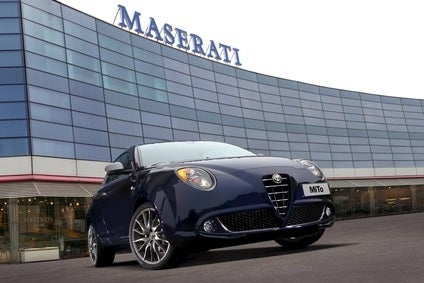
Does an eight-fold increase in sales at Maserati presage Fiat-Chrysler as a contender in the premium market? Ray Hutton considers the challenges ahead as part of Sergio Marchionne’s bold strategy for growth.
For most of this year, Maserati has been celebrating its 100th birthday. The closing event of the centenary festivities was the unveiling of a plaque on a building in the centre of Bologna, where the Maserati brothers established their first workshop in 1914 and adopted the city’s trident symbol as its badge.
Go deeper with GlobalData


Discover B2B Marketing That Performs
Combine business intelligence and editorial excellence to reach engaged professionals across 36 leading media platforms.
Nostalgia, in the form of parades, exhibitions and rallies for enthusiastic Maserati owners, has been good for business. Maserati is on a roll. The latest Quattroporte and its companion middleweight model, the Ghibli, have propelled it into the premium sedan market and achieved its highest-ever sales volume.
Although it has periods of big success in racing, Maserati doesn’t have a great history as a car maker. It didn’t offer a production touring model until after World War II, when the founding brothers (who were really only interested in racing) left the company, and it became part of the Orsi industrial group in Modena. In the 1960s, Maserati was better known for spark plugs and air horns than the few exotic cars it made for rich playboys, sportsmen and film stars.
In 1969, Ferrari, just down the road in Maranello, was embraced by the Fiat empire. Maserati, which was making a few hundred expensive GT cars a year, was close to collapse. It was acquired by Citroen, which was itself going broke, and after only six years Maserati fell into the hands of racing entrepreneur Alejandro de Tomaso. He increased production by building a series of smaller, cheaper but wholly unremarkable cars which did nothing for Maserati’s already shaky reputation.
When the de Tomaso era failed, the Italian government organised a transfer of assets to Fiat, bringing together Ferrari and Maserati, once the greatest rivals on road and track. In 1997, Maserati was placed under the management of Ferrari, with Luca di Montezemolo as president. And that, in a nutshell, is how Maserati came to be where it is today.
By the time Sergio Marchionne arrived to shake up Fiat in 2004, Maserati had been brought back into Fiat Auto (though its V8 engines were still designed and produced in Maranello – as they are today). Marchionne envisioned a progression through the Group’s car marques, from inexpensive workaday Fiats, through posher Alfa Romeo, to sports-luxury Maserati. The last two, as premium brands, could share componentry and facilities. Ferrari, even before an IPO was in prospect, would remain apart, an exclusive sales proposition.
As is his way, the hard-driving Marchionne burnt out several senior executives charged with developing this strategy and who failed to meet his hugely ambitious targets. Now he seems to have found the perfect custodian. Harald Wester, Fiat’s chief technical officer, is also in charge of the Alfa Romeo and Maserati brands. A cool, methodical and unflustered German who used to work at Ferrari, Wester accepts and agrees with Marchionne’s optimistic plans. In 2012, when Maserati sold 6,300 cars, the target was set at 50,000 a year by 2015 – an eight-fold increase that sounded, to everyone except Marchionne and Wester, like mission impossible.
Wonder of wonders, as 2014 draws to a close, it looks as if it is going to be achieved. Expansion in the Chinese and the US markets and the entry of the new Ghibli in the BMW 5-Series segment will bring this year’s sales total to something over 35,000. There is more to come from Ghibli and in the autumn of 2015 Maserati will start production of the Levante, its first SUV crossover. The Levante, based on the Quattroporte/Ghibli platform, is expected to sell 20,000 cars in a full year.
For Marchionne, the only way is up, so he has now raised overall the target for Maserati to 75,000 units by 2018. So far, at least, Wester has not demured.
He is, in any case, now preoccupied with the renaissance of Alfa Romeo, which is an even tougher job. Years of prevarication and mind-changing left Alfa with a two-model range (Mito and Giulietta) which was only really saleable in Europe. Sales dropped below 75,000 last year. The latest target of 400,000 cars a year by 2018 doesn’t seem remotely attainable but Marchionne defends it, saying, with a twinkle in his eye, ‘miracles are possible’.
Everything at Alfa, perhaps even its survival, depends on a new rear-wheel drive Giulia sedan due for launch on 24 June 2015. This car and its variants have been developed by a hand-picked team of Fiat engineers and designers based at a ‘skunk works’ at Maserati in Modena, well away from the FCA technical centre in Turin.
This – and the fact that the low-volume Alfa 4C sports car is made at Maserati – seems to suggest the synergy between the two marques that Marchionne had anticipated. Wester says that isn’t the case – he regards Alfa and Maserati as completely separate brands, with a different approach and different customers.
The sharing of facilities is, he says, simply a question of industrial logic. Maserati had the space and skills to build the 4C in Modena, because the Quattroporte and Ghibli were transferred to the former Bertone factory, renamed the Avv. Giovanni Agnelli plant, at Grugliasco, outside Turin. Alfas won’t be made there and neither will the Levante, which is earmarked for the Fiat Mirafiori production centre.
Together or not, the success of Alfa Romeo and Maserati is crucial for the future expansion of Fiat and Chrysler. With European markets remaining flat and limited possibilities for growth in the Fiat, Chrysler and Dodge brands, FCA needs a share of the burgeoning premium sector.
At present, the Group’s star turn is Jeep, which is not premium in the generally accepted sense of the term but has an enviable reputation for versatile, go-anywhere vehicles and SUVs are the other still-expanding sector. If Marchionne – and Wester – can make it work, Jeep+Alfa+Maserati would give FCA a range to compete worldwide with the German moneyspinners BMW, Audi and Mercedes-Benz. But it is, as they say in Detroit, a big ask.




